What is the difference between artificial intelligence and a normal computer program?
www.yzokul.com.tr
- Category AI Resources
- Format PDF
- Size 8.3 MB
- Added 01.11.2026
- Views 2
This book answers a beginner's question: what is the difference between artificial intelligence and a normal computer program? It explains that in a normal program, the programmer writes the rules explicitly, while a learning artificial intelligence system gets some rules from patterns in examples. A discount program uses a fixed formula, but a sales forecast model can learn from past sales. The book shows that real applications usually combine both approaches, using simple words so readers with no prior knowledge can follow.
Read the Book
If the PDF does not appear, open it in a new tab.
A Chapter from the Book
What is the difference between artificial intelligence and a normal computer program? www.yzokul.com.tr
What is the difference between artificial intelligence and a normal computer program? The short answer: a normal program follows rules that a person wrote, while a learning artificial intelligence system gets some of its rules from examples. This book explains that difference step by step, using simple words. By the end, you will understand how the two approaches work and how they are often used together. 1
A computer program is a set of instructions that the computer follows step by step. It does exactly what it is told, nothing more and nothing less. For example, a program that adds two numbers will always add them when you run it. The computer does not decide to do something else; it just follows the instructions in order. 2
In a normal program, the programmer writes the rules explicitly. The programmer decides each step in advance and types it into the code. For example, to check if a number is even, the programmer writes a rule like: if the number divided by two has no remainder, then it is even. The computer does not figure out the rule; it just follows what is written. 3
Consider a simple discount program that uses a fixed formula. The programmer writes a rule such as: take ten percent off the price. The program then applies this formula to any price you give it. For a price of 50, it calculates 10% of 50 (which is 5) and subtracts it to get 45. The formula is written by the programmer, and the program just applies it. 4
A normal program gives the same answer for the same input because its rules never change on their own. It only changes if a person edits the rules. For example, if the discount program always takes ten percent off, then every time you input 100, it will output 90. It will not start giving a different discount unless someone changes the code. 5
Every program needs rules from somewhere. The key question is whether a person writes them or the system finds them in data. In a normal program, a person writes the rules. In a learning artificial intelligence system, the rules are partly found by looking at examples. Understanding this difference helps you see what makes AI special. 6
A learning artificial intelligence system, instead of being told every rule, looks at many examples and picks up relationships inside them. For instance, to recognize cats in photos, you show it many photos labeled cat or not cat, and it learns what features are common to cats. The programmer sets up the learning process, but the detailed rules come from the examples. 7
A model that makes sales forecasts can use past sales data to predict future sales. Nobody writes the exact forecast rule; the model finds patterns in the earlier numbers. For example, it might notice that sales go up before holidays. Then it uses that pattern to forecast future sales. The model learns from the data instead of following a fixed formula. 8
The AI system gets some of its rules from patterns in the examples it was given. The programmer sets up the learning, but the details come from the data. For example, in a spam filter, the programmer provides many emails labeled spam or not spam, and the system learns which words or features are common in spam. The rules for what makes an email spam are not written by hand; they are learned from the examples. 9
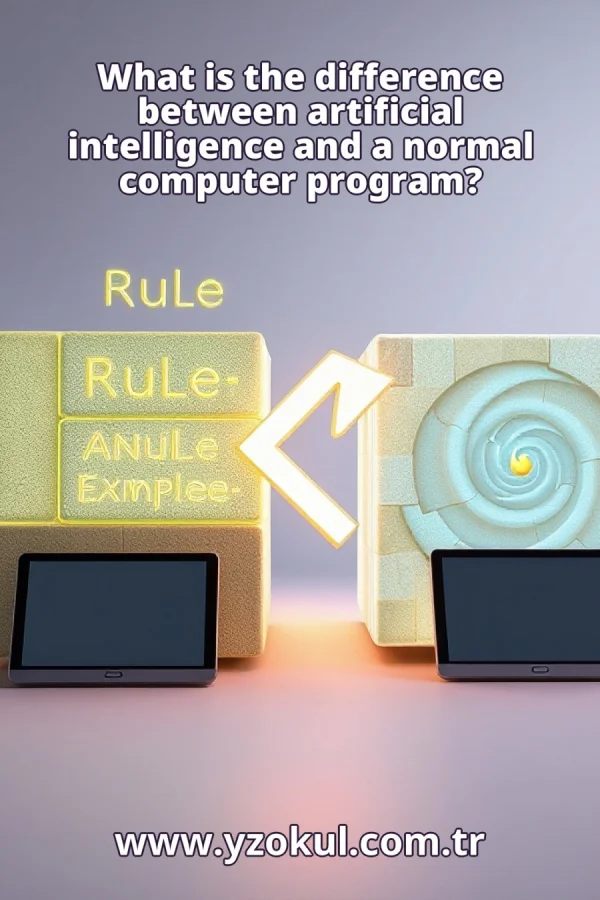
Compare the two approaches side by side. On one side, handwritten rules: a person writes every step, like a recipe. On the other side, rules learned from examples: the system finds patterns in data, like a student learning from experience. Both are still computer programs doing a job. The difference is where the rules come from. 10
Each approach has its place. Fixed rules are clear and predictable, which is good for tasks like calculating taxes where you need exact answers every time. Learning from examples helps when the patterns are hard to write down by hand, such as recognizing faces in photos. Neither is always better; you choose based on the problem. 11
Real applications usually combine both approaches. A system may use a written formula for some parts and a learned model for others. For example, a shopping website might use a fixed rule to calculate shipping costs, but use a learned model to recommend products you might like. The two work together to make the system useful. 12
A common mistake is to think that AI is something completely different from a program. An AI system is still a computer program; only the source of some rules is different. It runs on the same kind of computer and follows instructions. The key difference is that some rules are learned from data rather than written by a person. 13
Another mistake is to think that a learning system knows everything by itself. It only learns from the examples it is given, and its answers depend on that data. If you train a sales forecast model only on winter data, it may not predict summer sales well. The system is only as good as the examples it has seen. 14
It is not true that normal programs and learning are opposites. A normal program can also be part of a learning system, and the two work together. For example, a learning system might use a normal program to clean up data before learning from it. The normal program handles the fixed steps, while the learning part finds patterns.
This section is a preview taken from the book (about 945 words). To continue, read the book or download the PDF.
Book Details
- Book
- What is the difference between artificial intelligence and a normal computer program?
- Author
- www.yzokul.com.tr
- Category
- AI Resources
- Language
- English
- Format
- PDF · 8.3 MB
- Pages
- 18
- Words
- about 996
- Published
- kaynak.yzokul.com.tr · 01.11.2026
- Access
- Free to read and download; for personal use only, all rights belong to the author.
Frequently Asked Questions
Is the PDF of What is the difference between artificial intelligence and a normal computer program? free?
Yes. What is the difference between artificial intelligence and a normal computer program? can be read and downloaded for free on this site; no sign-up or payment is required.
How many pages is What is the difference between artificial intelligence and a normal computer program??
What is the difference between artificial intelligence and a normal computer program? has 18 pages and about 996 words.
Which devices can I read What is the difference between artificial intelligence and a normal computer program? on?
It is a PDF; you can read it in your browser on a phone, tablet or computer, or download it and open it offline.
Who is the author of What is the difference between artificial intelligence and a normal computer program??
What is the difference between artificial intelligence and a normal computer program? was written by www.yzokul.com.tr; it is listed in the AI Resources category.