What is a processor core?
www.yzokul.com.tr
- Category AI Resources
- Format PDF
- Size 6.6 MB
- Added 01.11.2026
- Views 2
This beginner-friendly book answers the question of what a processor core is. It follows a simple path: first it explains that a core is a unit inside the processor that executes instructions. Then it shows how multiple cores can run suitable tasks at the same time, using video processing as an example. Finally, it makes clear that not every program benefits equally and that doubling cores does not always double program speed. The explanation assumes no prior knowledge and uses plain language throughout.
Read the Book
If the PDF does not appear, open it in a new tab.
A Chapter from the Book
What is a processor core? www.yzokul.com.tr
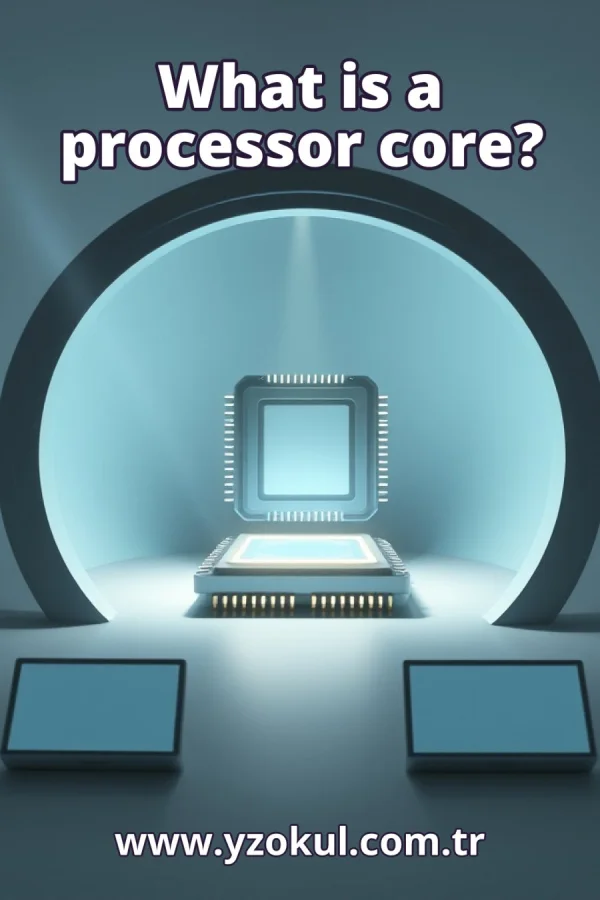
What is a processor core? The short answer is that a core is a unit inside the processor that executes instructions. The processor is the part of a computer that does the thinking work. A core is one of the workers inside it that carries out the steps programs ask for. This book explains that answer step by step, in plain language, for a complete beginner. 1
The processor is the part of a computer that does the thinking work. It carries out the steps that programs ask for, such as calculating numbers, moving data, or making decisions. Without a processor, a computer could not run any program at all. Think of it as the engine that turns your commands into actions. 2
A program is made of many small instructions. Each instruction is one tiny step of work, like add these two numbers or move this piece of data from one place to another. A web browser, a game, and a video editor are all built from thousands of such instructions. The computer runs them one after another to get the job done. 3
A core executes instructions. It is the unit that actually carries out the steps, one after another, in the order the program gives them. You can picture a core as a worker at a desk, taking each instruction and doing it. The core is where the real work of running a program happens. 4
A processor is a chip, a small piece of silicon, and it contains one or more cores inside it. The core is a part of the processor, not a separate device you plug in. When you read that a computer has a quad-core processor, it means one chip with four cores inside. Each core sits alongside the others on the same chip. 5
A single core handles instructions in sequence, one after another. It cannot do two instruction steps at the exact same moment. If the first step is to add two numbers and the second is to store the result, the core finishes the first before starting the second. This one-at-a-time order is how a single core works. 6
A processor can contain several cores working side by side. Each core can carry out its own instructions at the same time as the other cores. With four cores, four separate streams of instructions can move forward together. This is called parallel work: several things happening at once instead of one after another. 7
Some tasks can be cut into independent pieces. Each piece can then be given to a different core, and the cores work on their pieces at the same time. The pieces must not depend on each other, or the plan breaks down. When a task splits cleanly, multiple cores can share the load. 8
Video processing is a good example. A video is a long series of frames, and different sections of those frames can be handled separately. One core can process the first part while another core processes the second part. Different cores work on different parts at the same time, and the results are joined back together. 9
Splitting the video work helped because the parts finished in parallel instead of one after another. If one core would take an hour to process the whole video, two cores sharing the parts can finish sooner. This can make that suitable task go faster. The gain comes from doing independent pieces at the same time. 10
Not every task splits into independent pieces. Many programs have steps that must happen in order, where each step needs the result of the one before. Such work cannot be freely handed to many cores at once. A long chain of dependent steps stays on one core, no matter how many cores the processor has. 11
When one step depends on another, cores may have to wait. A core that has finished its piece cannot start the next piece until the earlier result is ready. During that wait, the extra core sits idle instead of helping. Waiting cores add no speed to a chain of dependent work. 12
Doubling the number of cores does not mean every task becomes twice as fast. The benefit depends on whether the task can be split well. A task that splits perfectly might come close to doubling its speed, but a task full of dependent steps may barely improve. More cores help only as much as the task allows. 13
A common mistake is to think that more cores always means a faster computer for everything. More cores only help tasks that can use them. For browsing a simple document or running a step-by-step calculation, extra cores may sit unused. Check what kind of work you do before assuming more cores will speed it up. 14
Another common mistake is to think that each core runs a whole separate program by itself. Cores execute instructions, and a program's work may be spread across several cores or stay on one. The operating system decides how to share the work. A core is not tied to one program; it simply runs the instructions it is given. 15
What to remember: a core is a unit inside the processor that executes instructions. A single core works one step at a time, while multiple cores can run suitable tasks at the same time. Not every program benefits equally, and doubling cores does not always double program speed. The benefit depends on how well the task can be split.
This section is a preview taken from the book (about 925 words). To continue, read the book or download the PDF.
Book Details
- Book
- What is a processor core?
- Author
- www.yzokul.com.tr
- Category
- AI Resources
- Language
- English
- Format
- PDF · 6.6 MB
- Pages
- 18
- Words
- about 926
- Published
- kaynak.yzokul.com.tr · 01.11.2026
- Access
- Free to read and download; for personal use only, all rights belong to the author.
Frequently Asked Questions
Is the PDF of What is a processor core? free?
Yes. What is a processor core? can be read and downloaded for free on this site; no sign-up or payment is required.
How many pages is What is a processor core??
What is a processor core? has 18 pages and about 926 words.
Which devices can I read What is a processor core? on?
It is a PDF; you can read it in your browser on a phone, tablet or computer, or download it and open it offline.
Who is the author of What is a processor core??
What is a processor core? was written by www.yzokul.com.tr; it is listed in the AI Resources category.