What does the processor do?
www.yzokul.com.tr
- Category AI Resources
- Format PDF
- Size 7.9 MB
- Added 01.11.2026
- Views 1
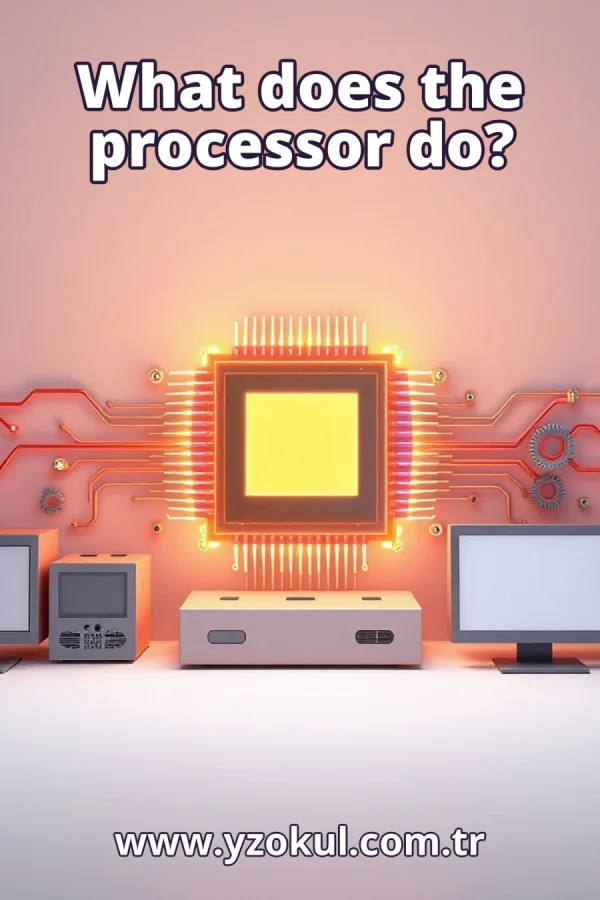
This book answers the question of what the processor does. It follows a beginner-friendly path, starting from zero: the processor carries out program instructions and performs arithmetic, logical, and control operations. It takes instructions and data from memory, does the needed operations, and sends results to the right places, such as comparing two numbers. The book also explains that the processor does not do all the work alone but works with other computer parts, and that modern processors have complex internal structures to run many operations efficiently.
Read the Book
If the PDF does not appear, open it in a new tab.
A Chapter from the Book
What does the processor do? www.yzokul.com.tr
A processor is the part of a computer that carries out program instructions. When you open an app, play a game, or type a letter, the processor is doing the work behind the scenes. It performs arithmetic, logical, and control operations. This book answers the question step by step, starting from zero, so you can understand exactly what the processor does. 1
A computer is made of several parts that work together. There is a screen to show you things, memory to hold information, and a processor to do the work. The processor is one important part, but it is not the whole computer. Each part has its own job, and they all cooperate to make the computer run. 2
An instruction is a single small command that tells the computer to do one thing, like add two numbers or move a value. Instructions are very simple, but when you put many of them in a row, they form a program. A program is just a long list of instructions that the computer follows in order. Every app and game is made of thousands of such instructions. 3
The processor's main job is to take instructions one by one and carry them out. Think of a worker following a list of steps: the worker reads the first step, does it, then moves to the next. The processor does the same with program instructions. It reads each instruction, performs the action, and then goes on to the next one. 4
Instructions are stored in memory, which is like a large set of numbered boxes. The processor does not keep the whole program inside itself. Instead, it asks memory for the next instruction, and memory sends it back. This way, the processor can run very large programs without needing to hold them all at once. 5
The processor also needs data to work on. Data is the information the program uses, such as numbers, text, or true/false values. Like instructions, data is stored in memory. The processor takes data from memory when an instruction tells it to. For example, to add two numbers, it first fetches those numbers from memory. 6
One kind of operation the processor performs is arithmetic. Arithmetic means working with numbers using operations like addition, subtraction, multiplication, and division. When a program needs to calculate a sum, the processor does the math. For example, if an instruction says to add 5 and 3, the processor produces the result 8. 7
The processor can also do logical operations. Logical operations deal with true or false values, and with comparisons. For example, the processor can check whether one number is greater than another. The result of a logical operation is either true or false. This helps programs make decisions, like whether to continue a loop or stop. 8
Control operations are another type of operation. They decide which instruction the processor will do next. Normally, instructions are done in order, one after another. But sometimes a program needs to jump to a different part, for example if a condition is true. The processor handles these decisions, keeping the program running in the right order. 9
Comparing two numbers is a common task. The processor takes the two numbers from memory, compares them, and produces a result such as true if the first is larger, or false if it is not. This comparison can then be used to decide what to do next. For example, a program might compare a score to a target and show a message if the score is higher. 10
After the processor performs an operation, it sends the result to the right place. Often the result goes back to memory, so it can be used later. Sometimes it goes to another part of the computer, like the screen. The result does not just stay inside the processor; it is transferred where it is needed. 11
The processor does not do all the work by itself. It works together with memory and other parts of the computer. Memory supplies instructions and data, and other parts handle input and output. The processor coordinates with them to get the job done. Without these other parts, the processor could not function. 12
Modern processors have complex internal structures to run many operations efficiently. They can work on several instructions at once, and they use fast internal memory called caches to speed up access to data. These designs help the processor handle lots of work quickly. Even with this complexity, the basic job remains the same: carry out instructions. 13
A common mistake is to think the processor alone runs the whole computer. In reality, it depends on memory and other parts to get its work done. The processor cannot store the whole program or all data inside itself. It must fetch instructions and data from memory and send results back. So the processor is a key part, but not the only one. 14
Another common mistake is to believe the processor holds the whole program inside it. Programs and data live in memory, not in the processor. The processor fetches instructions from memory as it needs them. It may keep a few recent instructions in a small cache, but the full program stays in memory. This keeps the processor free to do its work. 15
The processor carries out instructions, performs arithmetic, logical, and control operations, and works with other parts of the computer. It takes instructions and data from memory, does the needed operations, and sends results to the right places. Remember that it does not do everything alone. These are the key points to remember about what the processor does.
This section is a preview taken from the book (about 948 words). To continue, read the book or download the PDF.
Book Details
- Book
- What does the processor do?
- Author
- www.yzokul.com.tr
- Category
- AI Resources
- Language
- English
- Format
- PDF · 7.9 MB
- Pages
- 18
- Words
- about 949
- Published
- kaynak.yzokul.com.tr · 01.11.2026
- Access
- Free to read and download; for personal use only, all rights belong to the author.
Frequently Asked Questions
Is the PDF of What does the processor do? free?
Yes. What does the processor do? can be read and downloaded for free on this site; no sign-up or payment is required.
How many pages is What does the processor do??
What does the processor do? has 18 pages and about 949 words.
Which devices can I read What does the processor do? on?
It is a PDF; you can read it in your browser on a phone, tablet or computer, or download it and open it offline.
Who is the author of What does the processor do??
What does the processor do? was written by www.yzokul.com.tr; it is listed in the AI Resources category.