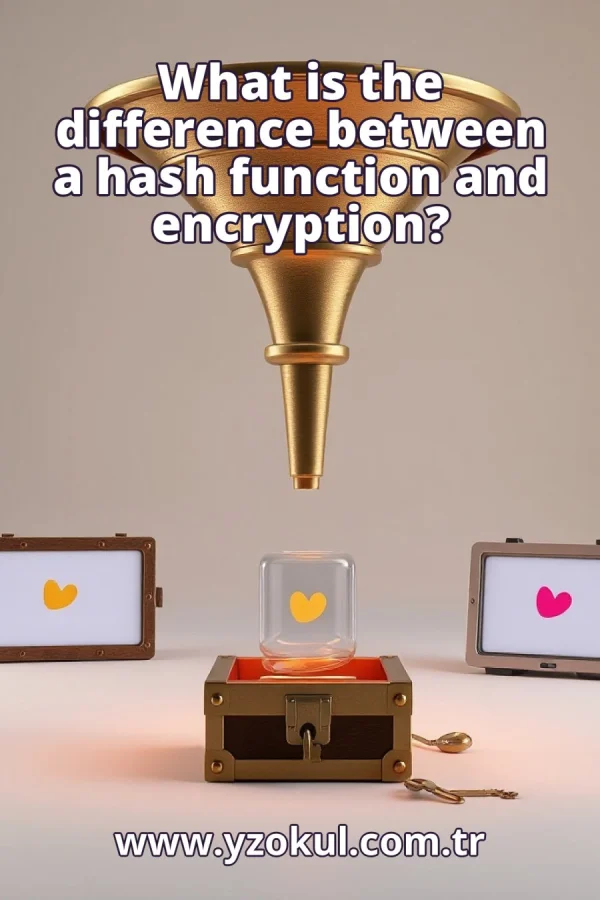
What is the difference between a hash function and encryption?
www.yzokul.com.tr
- Category AI Resources
- Format PDF
- Size 6.5 MB
- Added 01.11.2026
- Views 1
This book answers the question of how a hash function differs from encryption. It follows a beginner-friendly path, explaining that hashing turns data into a fixed-length value and is one way, so you cannot get the original data back, while encryption is reversible with the right key. It uses the example of comparing a hash to check whether a downloaded file has changed, and clarifies that a hash value is not a compressed copy of the file.
Read the Book
If the PDF does not appear, open it in a new tab.
A Chapter from the Book
What is the difference between a hash function and encryption? www.yzokul.com.tr
You see the question: what is the difference between a hash function and encryption? The short answer: a hash function is one-way and not meant to be reversed, while encryption is meant to be reversed with the right key. Hashing produces a fixed-length value from data. Encryption scrambles data so it can be restored later. These are two different tools with different purposes. 1
You picture data as any content, such as a text file, a photo, or a downloaded program. This is the starting point that both hashing and encryption can take as input. Data can be small like a short note or large like a video. The size and type of data do not matter for the basic idea. Both tools process data to produce an output. 2
You see a hash function take data of any size and produce a hash value of a fixed length. The same input always gives the same hash value. For example, hashing the text hello might give a short string of letters and numbers. A hash function is a mathematical process that turns data into a summary code. It is designed to be fast and repeatable. 3
You compare a tiny file and a huge file and see that both produce hash values of the same length. The length of the hash does not depend on the length of the input. For example, a one-word file and a thousand-page book both yield a hash of, say, 64 characters. This fixed length makes hashes easy to store and compare. 4
You see an arrow from data to hash value, but no working arrow back. A hash function is not intended to be reversible, so you cannot recover the original data from the hash. Even with the hash value, you cannot run the process backward to get the file. This one-way property is a key feature of hashing. It protects the original data from being reconstructed. 5
You see that a hash value is not a squeezed, decompressible copy of the file. Many different files can share the same hash length, and the hash does not contain the file's content. For example, a hash of a photo is not a smaller version of the photo. You cannot unzip or unpack a hash to get the original data back. A hash is just a fingerprint, not a container. 6
You see encryption take data and a key and produce scrambled output called ciphertext. The goal is to hide the data, not to summarize it. For example, encrypting a message with a password turns it into unreadable text. Only someone with the right key can decrypt it. Encryption is about secrecy and later recovery. 7
You see decryption turn the ciphertext back into the original data using the right key. Encryption aims to recover the original data, which is the key difference from hashing. For example, you encrypt a file with a password, then later decrypt it with the same password to get the file back. Without the key, decryption should be very hard. This reversibility is intentional. 8
You run the same file through the hash function twice and get the identical hash value both times. This repeatability is what makes hashes useful for comparison. For example, if you hash a document today and again tomorrow, the hash will be the same if the document has not changed. Any tiny change would produce a different hash. This consistency is reliable. 9
You see the example of a downloaded file: compare its hash with the expected hash to check whether the file has changed. If the hashes match, the file is unchanged; if not, something is different. For example, a website might list the hash of a program you download. You compute the hash yourself and compare. This is a common file check. 10
You change one small part of a file and see the hash value come out completely different. This shows how a hash reveals that data has changed. For example, changing a single letter in a text file will produce a totally new hash. The hash does not gradually change; it changes dramatically. This makes even small alterations easy to detect. 11
You place hashing and encryption side by side: hashing checks and summarizes data, while encryption hides and later restores data. They solve different problems. For example, you use a hash to verify a download and encryption to protect a message. Hashing is for integrity, encryption is for confidentiality. They are not interchangeable. 12
You correct the mistake of thinking a hash is a compressed file you can unpack. A hash value cannot be turned back into the original data. For example, you cannot take a hash of a document and decompress it to read the document. Compression is reversible; hashing is not. A hash is only a short code representing the data. 13
You correct the mistake of thinking a hash is just encrypted data. Encryption is reversible with a key, but hashing is not intended to be reversed at all. For example, you might think a hash is like a locked box, but there is no key to open it. Hashing and encryption are different operations. A hash is not a form of encryption. 14
You correct the mistake of expecting a key to turn a hash back into the data. There is no such key for a hash function; the key belongs to encryption and decryption. For example, you cannot find a password that reverses a hash to get the original file. Hashing has no decryption step. Keys are for encryption, not for hashing.
This section is a preview taken from the book (about 947 words). To continue, read the book or download the PDF.
Book Details
- Book
- What is the difference between a hash function and encryption?
- Author
- www.yzokul.com.tr
- Category
- AI Resources
- Language
- English
- Format
- PDF · 6.5 MB
- Pages
- 18
- Words
- about 1,005
- Published
- kaynak.yzokul.com.tr · 01.11.2026
- Access
- Free to read and download; for personal use only, all rights belong to the author.
Frequently Asked Questions
Is the PDF of What is the difference between a hash function and encryption? free?
Yes. What is the difference between a hash function and encryption? can be read and downloaded for free on this site; no sign-up or payment is required.
How many pages is What is the difference between a hash function and encryption??
What is the difference between a hash function and encryption? has 18 pages and about 1,005 words.
Which devices can I read What is the difference between a hash function and encryption? on?
It is a PDF; you can read it in your browser on a phone, tablet or computer, or download it and open it offline.
Who is the author of What is the difference between a hash function and encryption??
What is the difference between a hash function and encryption? was written by www.yzokul.com.tr; it is listed in the AI Resources category.