
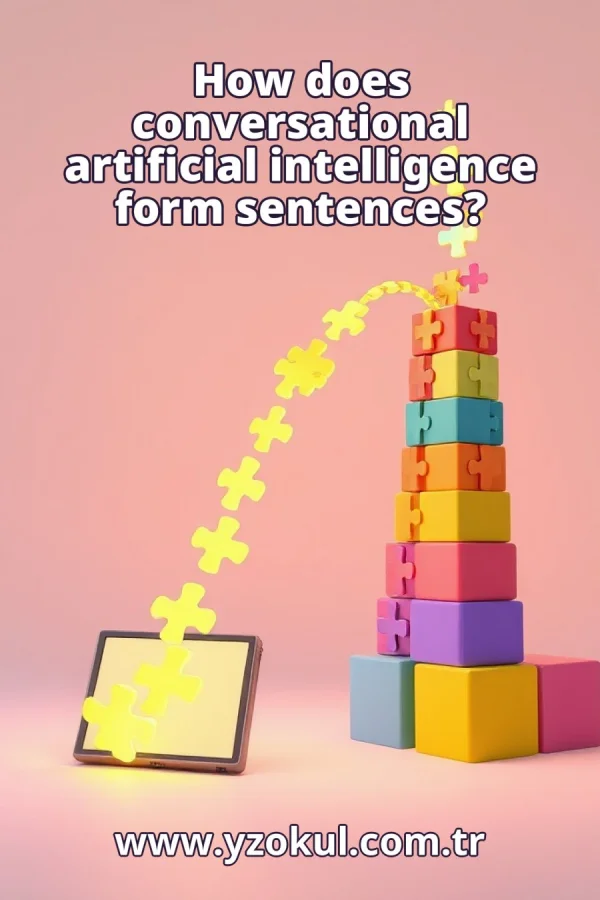
How does conversational artificial intelligence form sentences?
www.yzokul.com.tr
- Category AI Resources
- Format PDF
- Size 7.0 MB
- Added 01.11.2026
- Views 1
This book answers the question of how conversational artificial intelligence forms sentences. It explains the path from zero: a language model splits written text into small text pieces and calculates which next piece fits the current context. The answer is built by adding the chosen pieces one after another, using language and knowledge relationships learned during training. The system does not copy whole sentences from a ready-made store. The book also notes that fluent text does not mean every stated fact is independently verified.
Read the Book
If the PDF does not appear, open it in a new tab.
A Chapter from the Book
How does conversational artificial intelligence form sentences? www.yzokul.com.tr
You ask how conversational artificial intelligence forms sentences. The short answer: it picks small text pieces one after another, based on the current context, using patterns learned during training. This book explains each part of that process step by step, starting from zero. You will see how pieces become numbers, how the next piece is chosen, and why the result can look fluent but still contain errors. 1
Written text is first cut into small pieces, often parts of words. These pieces are the building blocks the system works with. For example, the word 'unbelievable' might be split into 'un', 'believ', and 'able'. This splitting lets the system handle any text, even new words, by reusing familiar pieces. The pieces are sometimes called tokens, and they are the smallest units the model processes. 2
Each small piece is turned into a number so a computer can handle it. The computer never sees letters the way you do; it works with these numbers. Every piece has a fixed number, like a code. For example, the piece 'cat' might become the number 3542. These numbers let the computer do math to compare and combine pieces. The mapping from pieces to numbers is set before training and stays the same. 3
The pieces already present form the context. The system looks at this context before choosing what comes next. Context includes all the pieces so far, such as the user's question and any answer built already. For example, after 'The sky is', the context suggests that 'blue' is a likely next piece. The model uses the entire context, not just the last piece, to make its choice. 4
The model calculates which piece fits best after the current context. It gives many possible pieces different likelihoods and picks one. Likelihood is a number showing how probable a piece is. For example, after 'I drink', pieces like 'water' or 'coffee' get high likelihoods, while 'car' gets a low one. The model does not pick the single most likely piece every time; it samples from the likelihoods, so answers can vary. 5
The chosen piece is added to the text, and then the whole thing repeats. Piece by piece, the answer grows. For example, after adding 'blue' to 'The sky is', the context becomes 'The sky is blue', and the model calculates the next piece. This loop continues until a stopping point, such as a maximum length or a special end piece. Each new piece depends on all previous pieces. 6
The calculation comes from patterns of language learned earlier from large amounts of text. These patterns guide which piece fits which context. During training, the model sees many examples of text and adjusts its internal numbers to predict the next piece better. For example, it learns that 'Thank' is often followed by 'you'. These patterns are statistical, not rules written by hand. The training text provides the raw material for all later choices. 7
The training text also carries knowledge links, such as which things often appear together. The model uses these links when choosing pieces. For example, it learns that 'Paris' often appears near 'France' and 'Eiffel Tower'. These links are not stored as facts but as patterns of co-occurrence. When forming a sentence about Paris, the model may favor pieces related to France. This is how knowledge influences sentence formation without explicit lookup. 8
The system does not look up and copy whole sentences from a stored collection. It builds each answer fresh from pieces. There is no database of ready-made sentences that it pastes together. For example, it does not find a stored sentence 'The cat sat on the mat' and copy it. Instead, it generates the sentence piece by piece, which is why the exact wording can be new each time. 9
Fluent text comes from good piece-by-piece choices, not from copying. The flow emerges from many small fitting decisions. Each piece is chosen to fit the context, so the overall sentence sounds natural. For example, the model might build 'The weather today is quite pleasant' by selecting each piece in turn. Because each choice is locally appropriate, the whole answer reads smoothly, even if it was never said before. 10
Smooth, fluent text does not mean every stated fact was checked. The model fits language; it does not confirm truth. For example, it might produce a fluent sentence with an incorrect date or name because the pieces fit the context well. Fluency is about language patterns, not about verifying facts against reality. You should treat confident answers as unverified unless you check them. 11
A common wrong idea is that the system pastes ready sentences. It does not. It assembles small pieces step by step. For example, it does not have a stored sentence for every possible question. Instead, it builds a new sentence from pieces each time. This is why the same question can get different answers on different occasions. The building process is dynamic, not a simple lookup. 12
Another wrong idea is that the model thinks or understands like a person. It calculates likely next pieces from learned patterns. It does not have beliefs, intentions, or consciousness. For example, it does not know what 'blue' looks like; it only knows which pieces tend to follow which contexts. Understanding in the human sense is not part of the process. The model is a statistical pattern machine.
This section is a preview taken from the book (about 907 words). To continue, read the book or download the PDF.
Book Details
- Book
- How does conversational artificial intelligence form sentences?
- Author
- www.yzokul.com.tr
- Category
- AI Resources
- Language
- English
- Format
- PDF · 7.0 MB
- Pages
- 18
- Words
- about 1,108
- Published
- kaynak.yzokul.com.tr · 01.11.2026
- Access
- Free to read and download; for personal use only, all rights belong to the author.
Frequently Asked Questions
Is the PDF of How does conversational artificial intelligence form sentences? free?
Yes. How does conversational artificial intelligence form sentences? can be read and downloaded for free on this site; no sign-up or payment is required.
How many pages is How does conversational artificial intelligence form sentences??
How does conversational artificial intelligence form sentences? has 18 pages and about 1,108 words.
Which devices can I read How does conversational artificial intelligence form sentences? on?
It is a PDF; you can read it in your browser on a phone, tablet or computer, or download it and open it offline.
Who is the author of How does conversational artificial intelligence form sentences??
How does conversational artificial intelligence form sentences? was written by www.yzokul.com.tr; it is listed in the AI Resources category.
Similar Books
 What is simulation?
www.yzokul.com.tr
 What is the difference between a microcontroller and a normal computer?
www.yzokul.com.tr
 What is a microcontroller?
www.yzokul.com.tr
 How does a program get information from the user?
www.yzokul.com.tr
 How does two-step verification work?
www.yzokul.com.tr
 What is the difference between a hash function and encryption?
www.yzokul.com.tr