
What is the difference between a list and an array?
www.yzokul.com.tr
- Category AI Resources
- Format PDF
- Size 6.1 MB
- Added 01.11.2026
- Views 1
This beginner-friendly book answers the question of how lists and arrays differ in programming. It explains that meanings vary by language: arrays are ordered structures accessed by position, sometimes with fixed length, while lists tend to be more flexible. The book follows a careful path, starting from zero prior knowledge and avoiding strict rules like lists always change and arrays never do, since a language's list may use a growable array behind the scenes.
Read the Book
If the PDF does not appear, open it in a new tab.
A Chapter from the Book
What is the difference between a list and an array? www.yzokul.com.tr
You may have heard the words list and array in programming and wondered how they differ. The short answer is that meanings vary by language, but in general arrays are ordered structures that give you access to items by position, and some have a fixed length. Lists tend to be more flexible. This book explains these ideas step by step from the beginning. 1
A program often needs to keep many pieces of data together, such as a set of names or a series of numbers. Storing each one in a separate variable becomes messy and hard to manage. To hold many items as one group, programs use structures like arrays and lists. These structures let you work with a collection as a single unit. 2
Ordered means each item sits in a numbered place, like seats in a row. The first seat is number one, the second is number two, and so on. In an ordered structure, the position of each item matters and stays consistent. This idea of position is the key to understanding arrays, because arrays rely on numbered places to find items. 3
An array lets you ask for the item at a given position, such as the third item. Picture a row of numbered boxes, each holding one value. To get a value, you name the box by its number. This position-based access is fast and direct, and it is a defining feature of arrays in most languages. 4
Some arrays have a fixed length, decided when the array is created. They cannot hold more items than that length allows. If you need more space, you must create a new, larger array and copy the items over. This fixed-length behavior is one common meaning of array in many programming languages. 5
Structures called lists often let you add or remove items more freely. You can usually append a new item to the end or insert one in the middle without recreating the whole structure. This flexibility is a tendency, not a strict rule, because the word list means different things in different languages. Still, lists are generally associated with easy growth and shrinkage. 6
There is no universal law that says lists always change and arrays never do. The words array and list mean different things in different programming languages. Some languages have fixed arrays and flexible lists, while others blur the line. Always check what the specific language means by each term rather than memorizing one rule. 7
A language's list may use a growable array behind the scenes. That means the list looks flexible on the outside, but inside it may store items in an array that can expand when needed. So a list can be flexible on the outside while using an array inside. This shows why simple rules about lists and arrays can be misleading. 8
The same word can mean different things in different programming languages. For example, an array in one language might have a fixed size, while an array in another language can grow. A list in one language might be a linked structure, while in another it might be a growable array. Checking the language's own meaning matters more than memorizing one rule. 9
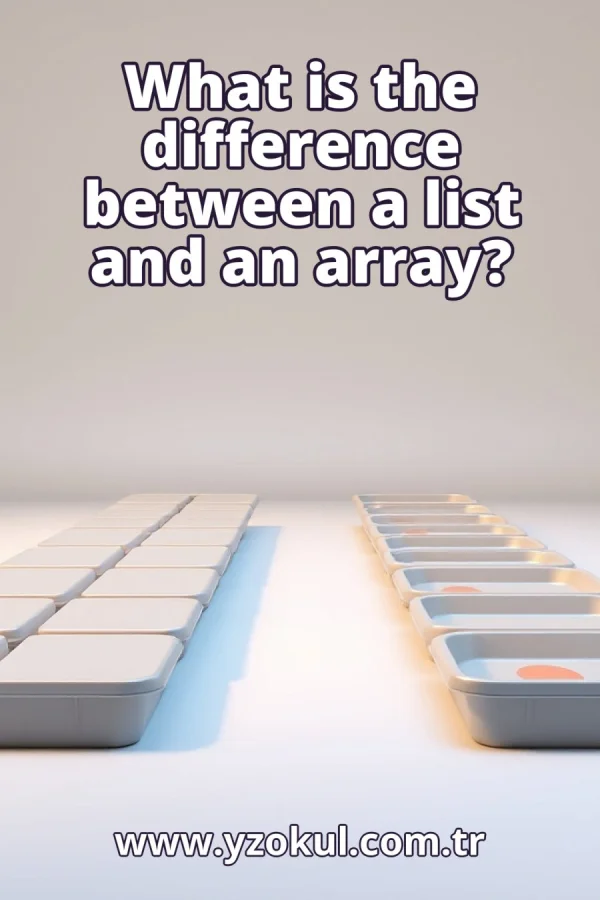
Picture a row of numbered boxes, each holding an item. The boxes are in a fixed order, and you can reach any item by its number. This simple picture shows how arrays work: positionbased access to items in a row. The numbers are the key, and the order never changes unless you replace an item. 10
Now picture a row that can gain or lose items at the end or in the middle. The row stretches or shrinks as needed, and the items shift to keep their order. This picture shows the flexible list idea. Comparing it with the fixed boxes makes the difference clear: arrays are often fixed, while lists tend to grow and shrink. 11
You can describe the difference in plain words: arrays are position-based and sometimes fixed in length; lists tend to be flexible and allow easy adding or removing. This summary is safe and accurate because it avoids absolute rules. It captures the general tendency without claiming that every language follows it. Use this description when you need a quick answer. 12
A common mistake is to assume that lists always change and arrays never do. This is not true in every language. Some arrays can grow, and some lists might have fixed behavior. The fix is to remember that meanings vary by language and to check the specific definitions rather than relying on a blanket rule. 13
Another mistake is to apply one language's rule to every language. For example, if you learn that arrays are fixed in one language, you might think all arrays are fixed. But other languages allow arrays to grow. The fix is to check how each language defines its own arrays and lists, because the same word can behave differently. 14
A third mistake is to forget that arrays are about position. Even if an array can grow, its items are still reached by their numbered place. The fix is to remember that position-based access is the core idea of arrays. Lists may also use position, but arrays are defined by it. Keep this in mind when choosing a structure. 15
This section is a preview taken from the book (about 900 words). To continue, read the book or download the PDF.
Book Details
- Book
- What is the difference between a list and an array?
- Author
- www.yzokul.com.tr
- Category
- AI Resources
- Language
- English
- Format
- PDF · 6.1 MB
- Pages
- 18
- Words
- about 960
- Published
- kaynak.yzokul.com.tr · 01.11.2026
- Access
- Free to read and download; for personal use only, all rights belong to the author.
Frequently Asked Questions
Is the PDF of What is the difference between a list and an array? free?
Yes. What is the difference between a list and an array? can be read and downloaded for free on this site; no sign-up or payment is required.
How many pages is What is the difference between a list and an array??
What is the difference between a list and an array? has 18 pages and about 960 words.
Which devices can I read What is the difference between a list and an array? on?
It is a PDF; you can read it in your browser on a phone, tablet or computer, or download it and open it offline.
Who is the author of What is the difference between a list and an array??
What is the difference between a list and an array? was written by www.yzokul.com.tr; it is listed in the AI Resources category.
Similar Books
 What is simulation?
www.yzokul.com.tr
 What is the difference between a microcontroller and a normal computer?
www.yzokul.com.tr
 What is a microcontroller?
www.yzokul.com.tr
 How does a program get information from the user?
www.yzokul.com.tr
 How does two-step verification work?
www.yzokul.com.tr
 What is the difference between a hash function and encryption?
www.yzokul.com.tr