
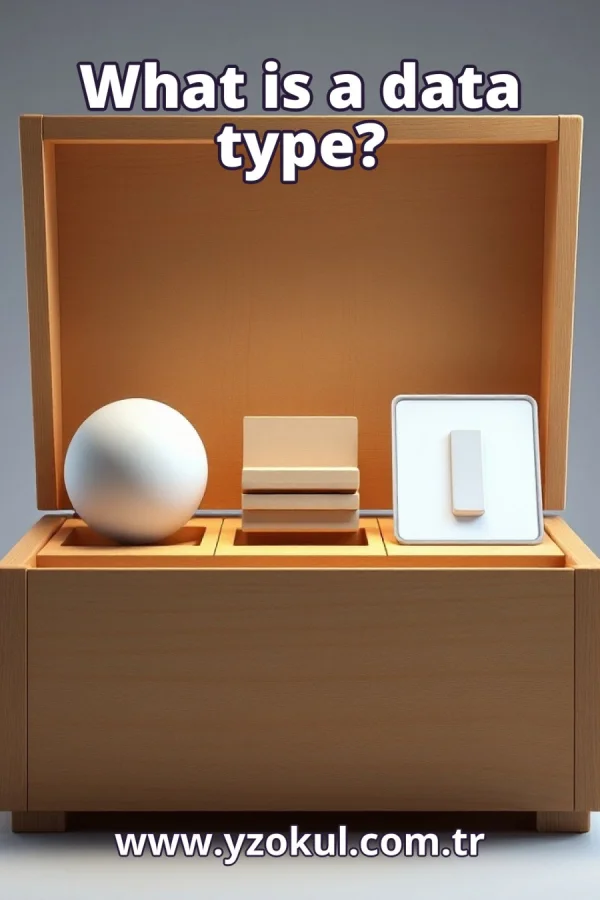
What is a data type?
www.yzokul.com.tr
- Category AI Resources
- Format PDF
- Size 5.7 MB
- Added 01.11.2026
- Views 1
This book answers the beginner question of what a data type is. It follows a simple path: a data type decides how a value is stored and what operations can be done with it. The book gives examples such as numbers, text, and true-false values, showing that you can add the number 5 but treat the text 5 as writing. It explains that type information helps programs handle values correctly, and that some languages require you to state types while others figure them out.
Read the Book
If the PDF does not appear, open it in a new tab.
Table of Contents
- The number type allows these operations because thep. 6
A Chapter from the Book: The number type allows these operations because the
Numbers like 5 and 12 are one data type. When a value is a number, the computer can do math with it. You can add, subtract, multiply, or divide numbers. For example, 5 + 3 gives 8. The number type allows these operations because the computer knows it is dealing with quantities. 4
Text like "hello" or "5" is another data type. Text is treated as writing, not as math. You can join text together, like "hello" + "world" to get "helloworld". You can also count the characters. But you cannot add text as if it were a number. The text type allows operations that make sense for writing. 5
True and false are a third data type. This type holds only two possible values: true or false. It is often called a boolean type. You use it for yes/no questions, like is the door open? The boolean type allows logical operations, such as and, or, not. For example, true and false gives false. 6
The number 5 and the text "5" look alike but are different data types. The number 5 is a quantity you can do math with. The text "5" is a character that you can print or join with other text. They are stored differently and allow different operations. Always check the type when values look similar. 7
With the number 5, you can do addition. For example, 5 + 3 equals 8. The computer performs math because it knows the value is a number. You can also multiply: 5 * 2 equals 10. These operations work because the data type is number. If the type were text, addition would not work the same way. 8
The text "5" is treated as writing. You can join it with other text, like "5" + " apples" to get "5 apples". You cannot add it to a number directly; that would cause an error or unexpected result. The type controls what operations make sense. For text, joining is the natural operation, not adding. 9
The data type decides which actions are allowed. Doing math on text or joining numbers as words would give wrong results. For example, if you try to add the text "5" and the number 3, the program may refuse or produce something odd. Understanding the type helps you choose the right operation. Always match the operation to the type. 10
Knowing the type helps the program handle each value correctly. It prevents mixing up numbers and text. For example, if you try to add a number to text, the program can warn you or convert the value safely. Type information acts like a set of rules that keep your data consistent. This reduces errors and makes programs reliable. 11
Some programming languages make you state the type yourself. You write the type explicitly when you create a value. For example, in Java you might write int age = 5; to say that age is a number. This clear statement helps the computer and other programmers know what kind of value it is. You are in control of the type. 12
Other languages figure out the type from the value you give. You do not write the type; the language infers it. For example, in Python you write age = 5 and Python knows it is a number. If you write name = "Alice", Python knows it is text. The type still matters, even though you did not state it. 13
A common beginner mistake is treating the text "5" like the number 5. They look the same but have different types. If you try to add 1 to the text "5", you might get an error or the text "51" instead of 6. Always check whether a value is a number or text. Use the right type for the job. 14
Another mistake is assuming any value can do any operation. The type limits what works. For example, you cannot multiply text by a number in most languages. Trying to do so causes errors. Ignoring the type leads to bugs. Always consider the type before choosing an operation. 15
A data type decides how a value is stored and what you can do with it. Numbers, text, and true-false are different types with different operations. For example, you can add the number 5 but only join the text "5". Type information keeps programs correct. Some languages require you to state types; others infer them. 16
This section is a preview taken from the book (about 741 words). To continue, read the book or download the PDF.
Book Details
- Book
- What is a data type?
- Author
- www.yzokul.com.tr
- Category
- AI Resources
- Language
- English
- Format
- PDF · 5.7 MB
- Pages
- 18
- Words
- about 938
- Chapters
- 1
- Published
- kaynak.yzokul.com.tr · 01.11.2026
- Access
- Free to read and download; for personal use only, all rights belong to the author.
Frequently Asked Questions
Is the PDF of What is a data type? free?
Yes. What is a data type? can be read and downloaded for free on this site; no sign-up or payment is required.
How many pages is What is a data type??
What is a data type? has 18 pages and about 938 words.
Which devices can I read What is a data type? on?
It is a PDF; you can read it in your browser on a phone, tablet or computer, or download it and open it offline.
Who is the author of What is a data type??
What is a data type? was written by www.yzokul.com.tr; it is listed in the AI Resources category.
Similar Books
 What is simulation?
www.yzokul.com.tr
 What is the difference between a microcontroller and a normal computer?
www.yzokul.com.tr
 What is a microcontroller?
www.yzokul.com.tr
 How does a program get information from the user?
www.yzokul.com.tr
 How does two-step verification work?
www.yzokul.com.tr
 What is the difference between a hash function and encryption?
www.yzokul.com.tr