
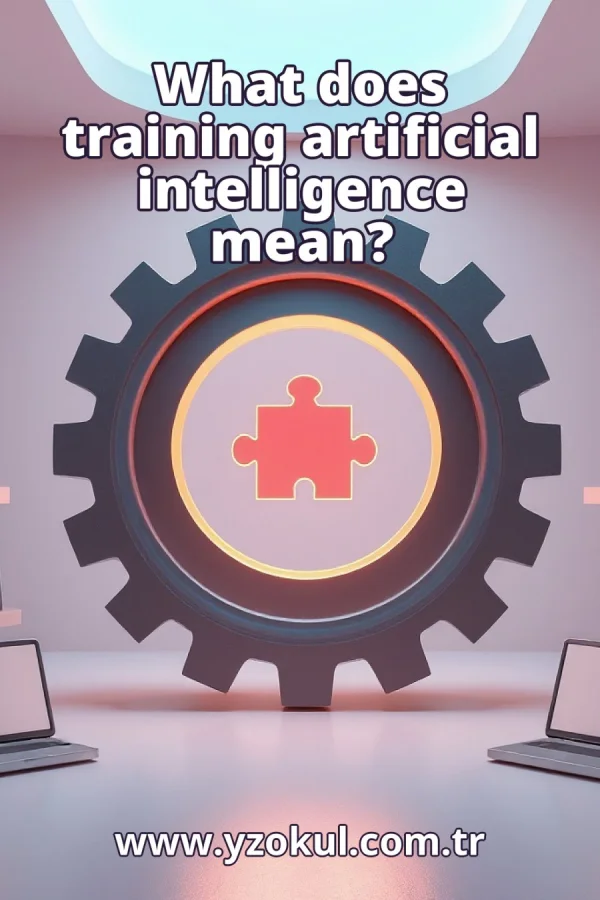
What does training artificial intelligence mean?
www.yzokul.com.tr
- Category AI Resources
- Format PDF
- Size 7.4 MB
- Added 01.11.2026
- Views 1
This book answers the question of what training artificial intelligence means, starting from zero for complete beginners. It explains that training adjusts a model using examples so it produces better results for specific tasks. The model's results are evaluated, and its internal parameters are changed depending on the method. The book compares this to a student doing exercises, though the computer works with numbers. Once training is finished, the model can be applied to new inputs, and asking a new question does not necessarily mean retraining it.
Read the Book
If the PDF does not appear, open it in a new tab.
A Chapter from the Book
What does training artificial intelligence mean? www.yzokul.com.tr
What does training artificial intelligence mean? The short answer is that training adjusts a model using examples so it produces better results for specific tasks. Training is how a computer program improves at a job by learning from data. This book explains each part of that process step by step, starting from the very beginning. 1
A model is a computer program that takes an input and produces an output. It is not magic; it is a set of numbers that turn input into output. These numbers are adjusted during training. You can think of the model as a machine with dials that are set to produce useful results. The model itself does not think; it calculates. 2
Here is a simple example: an input goes in, and the model produces an output. For instance, a picture goes in and a label like cat comes out. The input is the data you give the model, such as an image. The output is the model's response, such as a category or a number. This input-output flow is the basic operation of any model. 3
Training needs many examples, each with the correct answer. These examples are the material the model learns from. For a cat detector, you would collect many photos of cats and other animals, each labeled with the correct name. The model uses these examples to adjust its internal numbers. Without examples, there is nothing to learn from. 4
The model makes a first guess on an example and then compares it with the correct answer. The difference between guess and answer is the signal for learning. For instance, if the model guesses dog but the correct label is cat, that difference tells the model it needs to change. This comparison drives the training process forward. 5
The model's results are evaluated, for example by counting how often the guess was wrong. This evaluation tells you how far the model is from good results. You might test the model on many examples and measure the error rate. A high error rate means the model needs more adjustment. Evaluation is the feedback that guides training. 6
Inside the model there are adjustable numbers called parameters. These numbers shape how the model turns input into output. Parameters are like settings that control the model's behavior. During training, these parameters are the parts that get changed. The goal is to find parameter values that produce correct outputs for the examples. 7
Depending on the method used, the parameters are changed after evaluation. The change is aimed at making the next guess a little better. For example, if the model was wrong, the parameters are adjusted slightly in a direction that would reduce the error. This adjustment is done by a mathematical rule, not by hand. The method determines exactly how the change is made. 8
This loop of guess, compare, and adjust repeats over many examples. Each round nudges the parameters toward better results. The model sees one example, makes a guess, compares it to the correct answer, and adjusts its parameters. Then it moves to the next example. Over many rounds, the parameters gradually improve. 9
Training is like a student doing exercises and learning from mistakes. The difference is that the computer does numerical computation, not thinking. A student might solve math problems and check the answers, adjusting their approach. The computer does something similar but with numbers and formulas. It does not understand the subject; it just adjusts numbers. 10
What happens in the computer is calculation with numbers. The model does not understand like a person; it adjusts numbers to fit the examples. There is no awareness or comprehension involved. The model simply finds numerical patterns that map inputs to outputs. This is why training is a process of numerical optimization, not teaching in the human sense. 11
Training ends at some point, and the model is then fixed with its adjusted parameters. From then on it can be used for its task. The training phase stops when the model's results are good enough or after a set number of rounds. After that, the parameters are frozen. The model is now ready to be applied. 12
The trained model receives a new input it has never seen. It produces an output using what it learned during training. For example, you show it a new photo, and it labels it cat or dog based on its adjusted parameters. The model does not need the correct answer this time; it just produces its best guess. This is the payoff of training. 13
Asking a new question does not necessarily mean the model is retrained. The trained model simply answers new inputs; retraining is a separate decision. You can ask the model to classify many new pictures without changing its parameters. Retraining would only happen if you want to improve the model further or adapt it to a new task. So new inputs are handled by the already-trained model. 14
A common mistake is to think the model teaches itself from nothing. The model does not teach itself from nothing. It needs examples and an evaluation of its results to adjust its parameters. Without examples, there is no signal for learning. Without evaluation, it cannot know if it is improving. Training requires both data and feedback. 15
Training adjusts a model with examples, evaluates results, and changes parameters so it performs better on a task. After training, the model is applied to new inputs, and a new question does not automatically mean retraining. Remember that the model is a numerical program, not a thinking being. Training is the process that sets its parameters for good performance.
This section is a preview taken from the book (about 952 words). To continue, read the book or download the PDF.
Book Details
- Book
- What does training artificial intelligence mean?
- Author
- www.yzokul.com.tr
- Category
- AI Resources
- Language
- English
- Format
- PDF · 7.4 MB
- Pages
- 18
- Words
- about 953
- Published
- kaynak.yzokul.com.tr · 01.11.2026
- Access
- Free to read and download; for personal use only, all rights belong to the author.
Frequently Asked Questions
Is the PDF of What does training artificial intelligence mean? free?
Yes. What does training artificial intelligence mean? can be read and downloaded for free on this site; no sign-up or payment is required.
How many pages is What does training artificial intelligence mean??
What does training artificial intelligence mean? has 18 pages and about 953 words.
Which devices can I read What does training artificial intelligence mean? on?
It is a PDF; you can read it in your browser on a phone, tablet or computer, or download it and open it offline.
Who is the author of What does training artificial intelligence mean??
What does training artificial intelligence mean? was written by www.yzokul.com.tr; it is listed in the AI Resources category.
Similar Books
 What is simulation?
www.yzokul.com.tr
 What is the difference between a microcontroller and a normal computer?
www.yzokul.com.tr
 What is a microcontroller?
www.yzokul.com.tr
 How does a program get information from the user?
www.yzokul.com.tr
 How does two-step verification work?
www.yzokul.com.tr
 What is the difference between a hash function and encryption?
www.yzokul.com.tr