
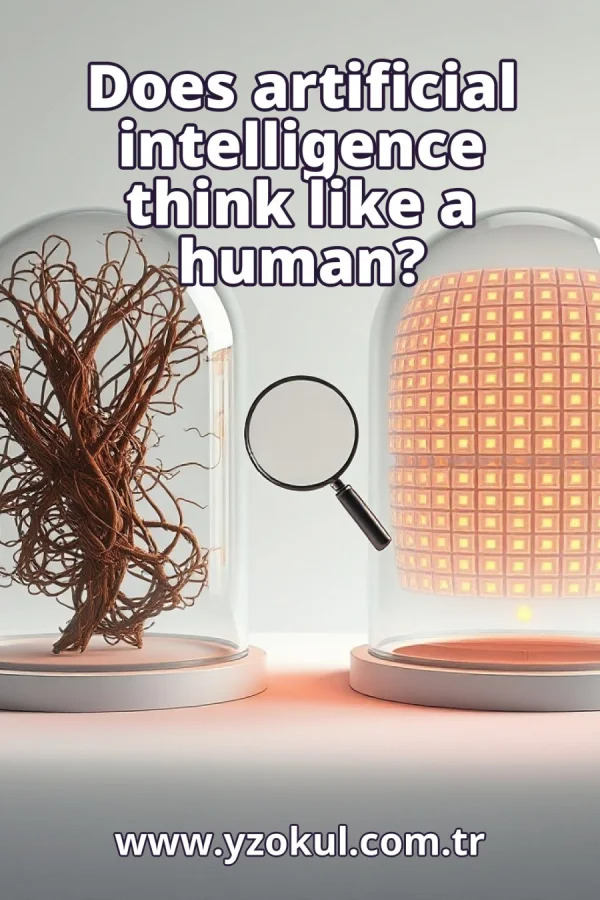
Does artificial intelligence think like a human?
www.yzokul.com.tr
- Category AI Resources
- Format PDF
- Size 7.9 MB
- Added 01.11.2026
- Views 1
This book answers whether artificial intelligence thinks like a human. It explains from zero that AI can produce results that look like human thought, but it works through numbers and computations, not like the human brain. Language models can explain things without having human-like inner experience. Since human thought is not fully understood either, the book shows why we must separate similar behavior from the same thinking mechanism, giving beginners a clear first look at this question.
Read the Book
If the PDF does not appear, open it in a new tab.
A Chapter from the Book
Does artificial intelligence think like a human? www.yzokul.com.tr
Does artificial intelligence think like a human? The short answer is no, not in the same way. AI can produce answers and results that look like human thinking, but the process inside is different. AI works through numbers and computations, while humans think with a living brain. This book explains why similar results do not mean the same thinking. 1
Thinking shows up as behavior you can observe. A person answers a question, solves a puzzle, or explains a mistake. You see the result and infer that thinking happened. The same is true for AI: you see its output and wonder what happened inside. Comparing behavior is useful, but it only tells you what something does, not how it does it. 2
Human thinking happens in a living brain. The brain contains billions of neurons, which are cells that send signals to each other. When you learn or remember, these cells form connections shaped by your senses and experience. Human thought is biological, grown from life, and tied to a body that feels and moves. This is the natural starting point for comparison. 3
A computer works differently. It follows exact steps using numbers and electrical signals. A processor performs operations on values stored in memory, very fast and very precisely. Computers do not grow from experience; they are built and programmed. This basic contrast, living brain versus machine steps, is what the rest of this book builds on. 4
A language model, a type of AI that produces text, turns words into numbers. Each word or piece of a word becomes a list of numbers called a vector, which is a set of values the model can calculate with. Inside, the model works with these numbers, not with words as you read them. The words you see are only the final output. 5
Those computed numbers must become readable words again. The model compares its number patterns with patterns learned from large amounts of text and picks likely next words. Step by step, it builds a sentence. This is how fluent, naturalsounding language can come from calculation rather than from human-style understanding of meaning. 6
Put a human answer and an AI answer side by side. Ask both why the sky looks blue, and both may mention light scattering. The outputs look alike, and you might assume the processes are alike too. They are not: one comes from a person's understanding and experience, the other from numerical patterns. Same output, different process. 7
A language model can explain its answer clearly. It may break a problem into steps, name the key idea, and give a reason. This explanation is itself produced by computation, word by word, from learned patterns. A clear explanation is impressive, but it does not by itself show what is happening inside the model or whether anything is felt. 8
A good explanation is not the same as lived experience. You can explain why a joke is funny without finding it funny yourself. You can describe pain without feeling it. Saying why something is true is a skill of organizing information. Having a human inner life means experiencing, feeling, and being aware, which is a different claim entirely. 9
Human thinking is still not fully understood. Scientists study the brain and behavior, but many details of how thought, awareness, and feeling arise remain open questions. Because the human side is not completely mapped, you cannot simply declare that AI matches it or does not match it in every way. The comparison has limits on both sides. 10
Now put the two ideas together. Similar behavior and the same thinking mechanism are separate claims. Behavior is what you can observe from outside. Mechanism is what happens inside to produce it. You can compare behavior directly, but claiming the same mechanism requires evidence about the inside. This distinction is the book's central tool. 11
A common mistake is assuming that human-like output means human-like thinking. If AI writes a kind poem, you might conclude it feels kindness. But the output alone does not show the mechanism. Using the central distinction, ask what produced the words: calculation and patterns, not necessarily human feeling. Looks human is not the same as thinks human. 12
Another common mistake treats a clear AI explanation as proof of inner experience. The model explains a problem well, so you assume it understands like a person. But explanation is output, produced by computation. It shows the model can organize information, not that it has felt or lived through anything. Explanation alone does not settle the question of experience. 13
The opposite mistake is dismissing AI as nothing but a simple calculator. A basic calculator adds and subtracts fixed numbers. Modern language models handle language, answer questions, and produce complex text. Their process is numerical, yes, but the outputs can be genuinely impressive. Calling it just a calculator understates what the computation achieves. 14
Review what the evidence supports. You can compare behavior: both humans and AI answer questions and explain ideas. What remains open is inner experience and the exact mechanism of human thought. Claims about whether AI feels or understands like a person need more than similar output. Behavior is observable; inner life is not directly visible. 15
Remember the difference. AI can behave in human-like ways through numbers and computation, but that is not the same as human thinking. Keep the habit of separating similar behavior from the same mechanism. When you see impressive AI output, ask what produced it and what evidence you actually have. That question keeps your thinking clear.
This section is a preview taken from the book (about 937 words). To continue, read the book or download the PDF.
Book Details
- Book
- Does artificial intelligence think like a human?
- Author
- www.yzokul.com.tr
- Category
- AI Resources
- Language
- English
- Format
- PDF · 7.9 MB
- Pages
- 18
- Words
- about 938
- Published
- kaynak.yzokul.com.tr · 01.11.2026
- Access
- Free to read and download; for personal use only, all rights belong to the author.
Frequently Asked Questions
Is the PDF of Does artificial intelligence think like a human? free?
Yes. Does artificial intelligence think like a human? can be read and downloaded for free on this site; no sign-up or payment is required.
How many pages is Does artificial intelligence think like a human??
Does artificial intelligence think like a human? has 18 pages and about 938 words.
Which devices can I read Does artificial intelligence think like a human? on?
It is a PDF; you can read it in your browser on a phone, tablet or computer, or download it and open it offline.
Who is the author of Does artificial intelligence think like a human??
Does artificial intelligence think like a human? was written by www.yzokul.com.tr; it is listed in the AI Resources category.
Similar Books
 What is simulation?
www.yzokul.com.tr
 What is the difference between a microcontroller and a normal computer?
www.yzokul.com.tr
 What is a microcontroller?
www.yzokul.com.tr
 How does a program get information from the user?
www.yzokul.com.tr
 How does two-step verification work?
www.yzokul.com.tr
 What is the difference between a hash function and encryption?
www.yzokul.com.tr