
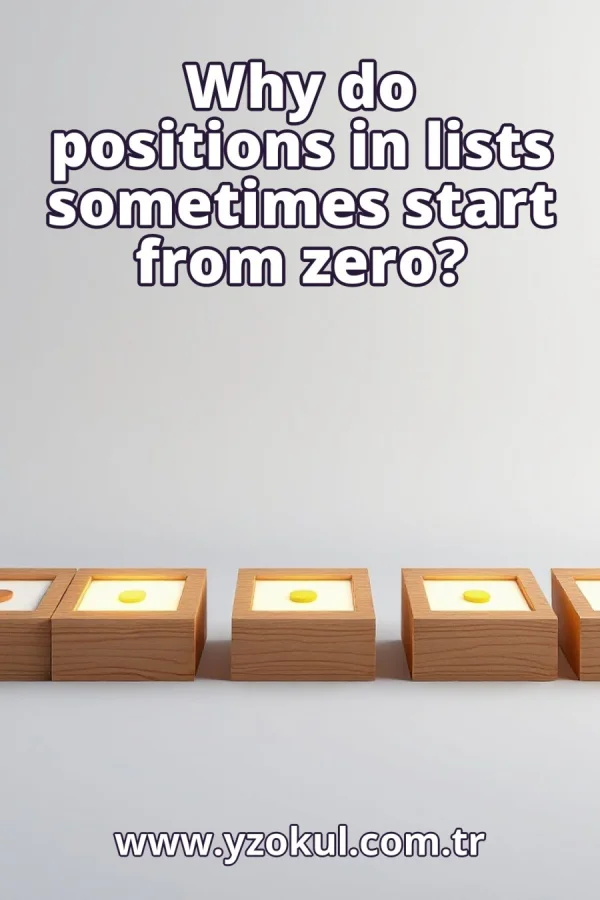
Why do positions in lists sometimes start from zero?
www.yzokul.com.tr
- Category AI Resources
- Format PDF
- Size 5.1 MB
- Added 01.11.2026
- Views 1
This book answers why list positions often start at zero in some programming languages. It explains zero based indexing for complete beginners: the first item index is zero because it shows the item's distance from the start, so the first item is zero steps away and the second is one. It notes that not all languages work this way and warns about a common mistake: in a five item list starting from zero, the last index is four, not five.
Read the Book
If the PDF does not appear, open it in a new tab.
A Chapter from the Book
Why do positions in lists sometimes start from zero? www.yzokul.com.tr
You meet the question: why do list positions sometimes start from zero? The short answer is that the first item's index is zero because it shows how many steps it is from the start. This idea is called zero based indexing. It is a way to number positions in a list, and it is used in many programming languages. Understanding this helps you avoid confusion when working with lists. 1
A list is a row of items, like five boxes with things inside. Each box has a position, and we use a number to point at each box. For example, a list of fruits might have an apple in the first box, a banana in the second, and so on. The position number is how we find a specific item. Lists are common in programming and everyday life. 2
Each item in a list gets a number called an index. The index is how we name and find a specific item in the list. For example, in a list of colors, the first color might have index zero, the second index one, and so on. The index is like a label that tells you where the item is. You use it to access or change the item. 3
Picture standing at the start of a line of boxes. The first box is zero steps away, because you are already there. You do not need to move to reach it. This is the key idea: the distance from the start is zero for the first item. So its index is zero. This way of counting steps is natural when you think about distance. 4
The first item's index is zero because it is zero steps from the starting point. This is the heart of zero based indexing. For example, if you have a list of three items, the first item is at index zero. You do not count it as one because you have not moved from the start. This makes zero the natural first number. 5
Move one step forward and you reach the second item. Its index is one, because it is one step away from the start. For example, in a list of letters, the second letter has index one. The pattern is: each step forward adds one to the index. So the second item is always one step from the start. 6
Take another step and you reach the third item, whose index is two. The pattern is clear: each step forward adds one to the index. For example, the third item in a list has index two. This continues for all items. The index tells you how many steps you are from the start. 7
The index of an item equals its distance in steps from the start. This makes zero a natural first number. For example, an item that is three steps away has index three. This rule works for any list, no matter how long. It is a simple and consistent way to number positions. 8
Look at a list with five items and count their indexes: zero, one, two, three, four. You see that the numbers go up by one each time. For example, a list of five names would have indexes zero through four. The first item is zero, the second is one, and so on. This shows how zero based indexing works in practice. 9
The last item in the five item list has index four, because it is four steps from the start, not five. For example, if the list has five items, the last one is at index four. This is a common point of confusion. Remember: the last index is always one less than the number of items. 10
Not all languages start counting at one instead of zero. Some languages use one based indexing, where the first item has index one. So zero based indexing is a choice, not a rule for every language. For example, some languages like Python use zero, while others like Lua use one. It depends on the language you use. 11
A common mistake is assuming a five item list ends at index five. The correct last index is four. This mix-up is called an off by one error. For example, if you try to access index five in a five item list, you will get an error because the indexes are zero to four. Always check the last index. 12
People slip because we usually count items starting from one. With zero based indexing, the count of items and the last index differ by one. For example, if you have five items, you might think the last index is five, but it is four. This happens because we are used to counting the first item as one, not zero. 13
For a list of any size, the last index is the number of items minus one. This quick check helps you avoid the mistake. For example, a list of ten items has last index nine. A list of two items has last index one. So if you know the number of items, you can find the last index easily. 14
Double check by asking how many steps from the start an item is. If it is the first item, the answer is zero. For example, if you are unsure about an index, count the steps from the beginning. The first item is zero steps, the second is one step, and so on. This simple question keeps you on track.
This section is a preview taken from the book (about 928 words). To continue, read the book or download the PDF.
Book Details
- Book
- Why do positions in lists sometimes start from zero?
- Author
- www.yzokul.com.tr
- Category
- AI Resources
- Language
- English
- Format
- PDF · 5.1 MB
- Pages
- 18
- Words
- about 994
- Published
- kaynak.yzokul.com.tr · 01.11.2026
- Access
- Free to read and download; for personal use only, all rights belong to the author.
Frequently Asked Questions
Is the PDF of Why do positions in lists sometimes start from zero? free?
Yes. Why do positions in lists sometimes start from zero? can be read and downloaded for free on this site; no sign-up or payment is required.
How many pages is Why do positions in lists sometimes start from zero??
Why do positions in lists sometimes start from zero? has 18 pages and about 994 words.
Which devices can I read Why do positions in lists sometimes start from zero? on?
It is a PDF; you can read it in your browser on a phone, tablet or computer, or download it and open it offline.
Who is the author of Why do positions in lists sometimes start from zero??
Why do positions in lists sometimes start from zero? was written by www.yzokul.com.tr; it is listed in the AI Resources category.
Similar Books
 What is artificial intelligence?
www.yzokul.com.tr
 How does an app idea turn into a working program?
www.yzokul.com.tr
 How does a three-dimensional printer produce a model?
www.yzokul.com.tr
 What is simulation?
www.yzokul.com.tr
 What is the difference between a microcontroller and a normal computer?
www.yzokul.com.tr
 What is a microcontroller?
www.yzokul.com.tr