
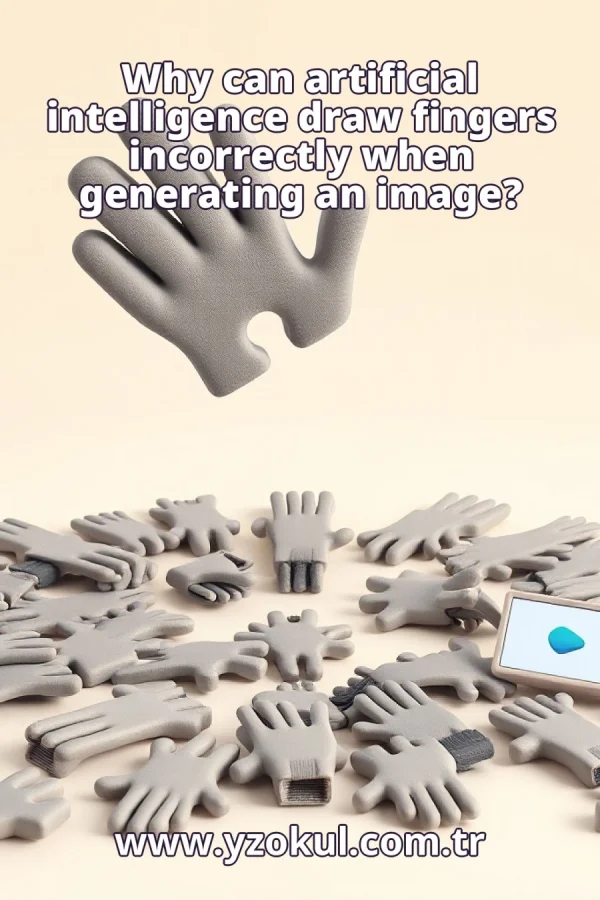
Why can artificial intelligence draw fingers incorrectly when generating an image?
www.yzokul.com.tr
- Category AI Resources
- Format PDF
- Size 7.2 MB
- Added 01.11.2026
- Views 1
This book answers why artificial intelligence can draw fingers incorrectly when generating an image. It explains from zero that a realistic-looking picture can still have structural errors. Hands are hard because they appear at different angles, with overlaps and movement. The model handles local patterns well but can miss whole relationships, such as the number of fingers. The book notes that texts and repeating objects can also be distorted, and that results vary with the method and the training data.
Read the Book
If the PDF does not appear, open it in a new tab.
A Chapter from the Book
Why can artificial intelligence draw fingers incorrectly when generating an image? www.yzokul.com.tr
You may have seen an AI-generated picture that looks like a photograph but has a hand with six fingers or a thumb in the wrong place. The short answer is that a picture can look realistic overall while some parts are still structurally wrong. The AI creates convincing textures and shapes but does not always keep the whole hand correct. This book explains why that happens, step by step. 1
Look at a generated image of a person. At first glance, the face, clothes, and background look real. Then you notice a finger that bends the wrong way or an extra finger. This shows that looking real is not the same as being correct. The overall impression can be convincing even when a small but important detail is wrong. 2
An image model is a computer program trained on huge numbers of example pictures. It learns patterns from these examples rather than following fixed rules about how a hand must be built. For instance, it sees many hands in many positions and learns what hand-like shapes tend to look like. It does not learn a rule that a hand has exactly five fingers. 3
The model is good at small local patterns, like skin texture or the shape of a single fingertip. These small details often look right. But the model can miss the whole structure, such as how many fingers a hand has or how they connect. For example, it may draw five realistic-looking fingers but place them in a way that adds up to six. 4
A hand is a complex shape with many parts: palm, thumb, four fingers, joints, and curves. All these parts must fit together in a consistent way. A small error in one part, like a finger that is too long or a joint that bends oddly, is easy to notice. That is why hands are a common place for structural mistakes. 5
The same hand can appear from the front, from the side, in a fist, or pointing. Each angle shows a different arrangement of fingers and palm. The model must handle many different views, and it may not have seen enough examples of every possible pose. For instance, a hand seen from the back at an odd angle can confuse the model. 6
When fingers cross over each other or over the palm, some parts of the hand are hidden. The model must guess what is behind the visible parts. For example, if two fingers overlap, the model might draw an extra finger to fill the space or lose track of which finger is which. Overlaps make the structure harder to get right. 7
A hand in motion, like waving or pointing, changes shape and can blur edges. Movement makes the structure less clear, so the model has less clear patterns to copy. For example, a quickly moving hand might be drawn with fingers that merge together or split apart. The model tries to create a realistic blur but may lose the correct number of fingers. 8
Look at a generated hand with four or six fingers. The model drew believable finger-like shapes, with skin texture and fingernails, but lost track of the whole count. It copied local patterns of fingers without keeping a consistent total. This is a clear example of local patterns working while the whole structure fails. 9
Hands are not the only place where this happens. You may see distorted text, like signs with garbled letters, or repeated objects like windows that do not line up. The same kind of error appears wherever many similar parts must stay consistent. The model copies local style but does not always keep the whole pattern correct. 10
Look at a generated image with text. The letters may look like real letters at a glance, but they are often garbled or misspelled. Similarly, rows of windows on a building may be uneven or have different sizes. These show the model copying local style without keeping the whole pattern correct, just like with fingers. 11
Different generation methods produce different results. Some methods keep structure better than others. For example, a method that focuses on overall shape may draw hands more correctly than one that focuses on fine details. So the success of models varies with the method used, and some methods are better at hands than others. 12
What the model saw during training shapes what it can draw. If the training examples rarely show clear hands, or show them mostly in similar poses, the model has less to learn from. For instance, if most training pictures show hands in pockets or holding objects, the model may struggle with open hands. Training data matters a lot. 13
A common belief is that the AI knows what a hand is, like a person does. But the AI does not understand anatomy; it reproduces patterns from its training. It has no concept of five fingers as a rule. For example, it may draw a hand that looks real but has no real understanding of how a hand works. 14
Another common mistake is thinking that one bad hand means the model always fails. In fact, results vary. The same model can draw hands well in one image and badly in another. For example, a simple pose might come out perfectly, while a complex angle fails. Each image is a new attempt, and success is not guaranteed.
This section is a preview taken from the book (about 914 words). To continue, read the book or download the PDF.
Book Details
- Book
- Why can artificial intelligence draw fingers incorrectly when generating an image?
- Author
- www.yzokul.com.tr
- Category
- AI Resources
- Language
- English
- Format
- PDF · 7.2 MB
- Pages
- 18
- Words
- about 970
- Published
- kaynak.yzokul.com.tr · 01.11.2026
- Access
- Free to read and download; for personal use only, all rights belong to the author.
Frequently Asked Questions
Is the PDF of Why can artificial intelligence draw fingers incorrectly when generating an image? free?
Yes. Why can artificial intelligence draw fingers incorrectly when generating an image? can be read and downloaded for free on this site; no sign-up or payment is required.
How many pages is Why can artificial intelligence draw fingers incorrectly when generating an image??
Why can artificial intelligence draw fingers incorrectly when generating an image? has 18 pages and about 970 words.
Which devices can I read Why can artificial intelligence draw fingers incorrectly when generating an image? on?
It is a PDF; you can read it in your browser on a phone, tablet or computer, or download it and open it offline.
Who is the author of Why can artificial intelligence draw fingers incorrectly when generating an image??
Why can artificial intelligence draw fingers incorrectly when generating an image? was written by www.yzokul.com.tr; it is listed in the AI Resources category.
Similar Books
 What is artificial intelligence?
www.yzokul.com.tr
 How does an app idea turn into a working program?
www.yzokul.com.tr
 How does a three-dimensional printer produce a model?
www.yzokul.com.tr
 What is simulation?
www.yzokul.com.tr
 What is the difference between a microcontroller and a normal computer?
www.yzokul.com.tr
 What is a microcontroller?
www.yzokul.com.tr