
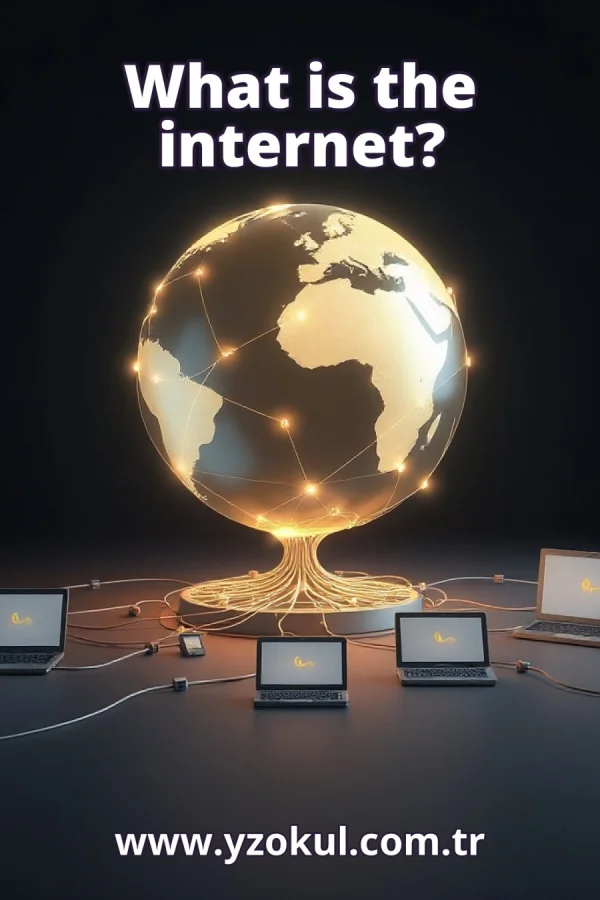
What is the internet?
www.yzokul.com.tr
- Category AI Resources
- Format PDF
- Size 7.1 MB
- Added 01.11.2026
- Views 1
This beginner guide answers the question of what the internet is. It explains internet basics from zero, describing the internet as a global network of connected networks that follow common communication rules. It shows how computers, phones and servers exchange data by splitting messages into small data packets, and stresses that the internet is not one computer or one company. Finally, it introduces websites, email and online games as online services built on this shared infrastructure, giving complete beginners a clear first picture.
Read the Book
If the PDF does not appear, open it in a new tab.
A Chapter from the Book
What is the internet? www.yzokul.com.tr
The question is simple: what is the internet? The short answer is that the internet is a global structure made of many networks connected to each other by common communication rules. This means it is not a single thing you can touch, but a system that lets computers, phones, and servers exchange data. Keep this first picture in mind as you read the details. 1
Picture one computer sitting alone on a desk, with no cable or wireless connection to anything else. It can run programs and store files, but it cannot send a message to another machine or look up a website. One computer by itself cannot be the internet, because the internet is about connections between machines. Something more is needed. 2
Join two computers with a cable so they can send data to each other. This is the smallest possible network: two machines that can talk. Each computer needs a way to send and receive signals over the cable. This simple link is the building block of everything bigger, because every larger network is just more connections like this one. 3
Now link several computers together in one small network, such as in a home or office. They share data through a central device or direct connections. A network is simply a group of machines that can talk to each other. With more computers, you can share files, printers, and messages, but you are still limited to your own group. 4
Connect one small network to another small network. When networks connect to networks, the result grows far beyond any single group of computers. Data can now travel from a machine in one network to a machine in the other. Each network keeps working on its own, but the link between them lets messages pass from one side to the other. 5
Imagine networks joining networks all over the world, forming one huge structure. This worldwide web of connected networks is what we call the internet. It is not in one place; it spans countries and oceans through cables, satellites, and other links. Any device connected to any part of this structure can, in principle, reach devices on other parts. 6
For connected computers to understand each other, they must follow the same communication rules. These rules, often called protocols, define how data is formatted, sent, and received. They are shared agreements that let machines from different places exchange data reliably. Without common rules, a message from one computer would be meaningless to another. 7
The internet connects many kinds of devices: computers, phones, and servers. Servers are machines that hold and send out data for others to use, such as web pages or email. Your phone or computer asks for data, and servers respond. All these devices follow the same communication rules, so they can work together even if they are different makes and models. 8
When you send a message, it is mostly divided into small pieces called packets before it travels. Each packet carries a part of the message and an address showing where it should go. Splitting data into packets lets it move efficiently across the network, because packets can take different paths and share the network with other traffic. This is how large messages travel. 9
Follow the small packets as they travel across the network. They may take different routes, passing through several networks and devices. At the end, the receiving computer puts the packets back together in the correct order. The message arrives complete even though it moved in pieces. This process happens quickly and is repeated for every message you send. 10
A common mistake is to think the internet is a single giant computer. It is not. The internet is many separate machines and networks working together, not one machine. No single computer holds all the data or controls all the connections. Instead, millions of devices cooperate by following the same rules, each playing a small part in the whole. 11
Another common mistake is to think the internet belongs to one company. No single company owns it. The internet is a shared structure of many connected networks, operated by different organizations and individuals around the world. They cooperate by using common rules, but no one central authority runs the whole thing. This shared ownership is what makes it open and global. 12
Websites, email, and online games are services that run on top of the shared network. The internet is the infrastructure; these are things built on it. The infrastructure carries data between devices, and the services use that data to do useful things. You can think of the internet as the roads, and these services as the vehicles that travel on them. 13
Picture each service in turn. A website page is a set of files that your browser requests from a server and displays. An email message is text and attachments sent from one mail server to another. An online game sends small updates between players' devices and game servers. All of them use the same underlying network of connected networks to move their data. 14
Review the key points. The internet is many networks joined by common communication rules. Data is sent in small packets that travel and rejoin. No single computer or company owns it. These facts are the core of the answer. Hold on to them as you learn more, because they explain how the internet works at the most basic level.
This section is a preview taken from the book (about 915 words). To continue, read the book or download the PDF.
Book Details
- Book
- What is the internet?
- Author
- www.yzokul.com.tr
- Category
- AI Resources
- Language
- English
- Format
- PDF · 7.1 MB
- Pages
- 18
- Words
- about 973
- Published
- kaynak.yzokul.com.tr · 01.11.2026
- Access
- Free to read and download; for personal use only, all rights belong to the author.
Frequently Asked Questions
Is the PDF of What is the internet? free?
Yes. What is the internet? can be read and downloaded for free on this site; no sign-up or payment is required.
How many pages is What is the internet??
What is the internet? has 18 pages and about 973 words.
Which devices can I read What is the internet? on?
It is a PDF; you can read it in your browser on a phone, tablet or computer, or download it and open it offline.
Who is the author of What is the internet??
What is the internet? was written by www.yzokul.com.tr; it is listed in the AI Resources category.
Similar Books
 What is artificial intelligence?
www.yzokul.com.tr
 How does an app idea turn into a working program?
www.yzokul.com.tr
 How does a three-dimensional printer produce a model?
www.yzokul.com.tr
 What is simulation?
www.yzokul.com.tr
 What is the difference between a microcontroller and a normal computer?
www.yzokul.com.tr
 What is a microcontroller?
www.yzokul.com.tr