
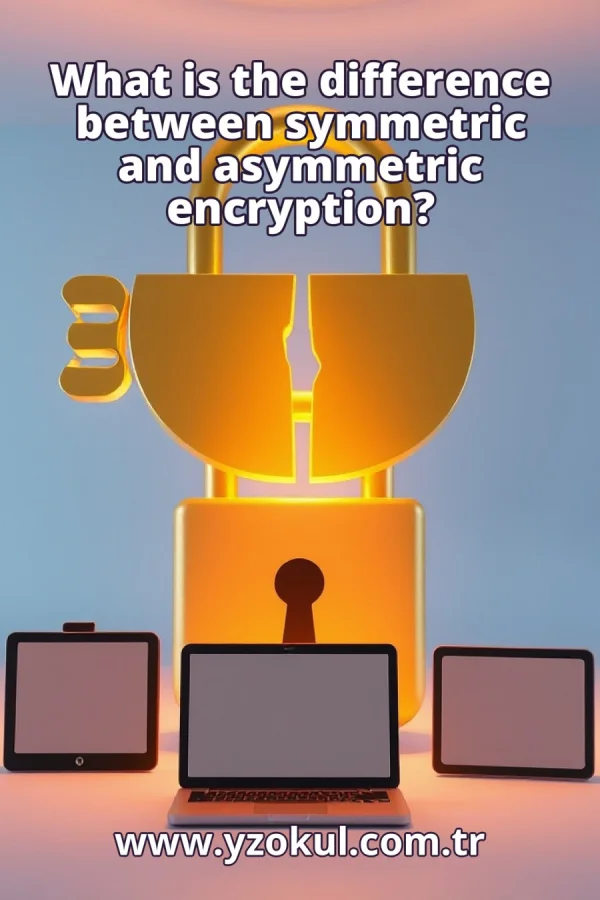
What is the difference between symmetric and asymmetric encryption?
www.yzokul.com.tr
- Category AI Resources
- Format PDF
- Size 7.0 MB
- Added 01.11.2026
- Views 2
This book answers the question of how symmetric and asymmetric encryption differ. It follows a path that starts with the basics: symmetric encryption uses one shared secret key for both locking and unlocking data, while asymmetric encryption uses a linked pair of keys, a public key anyone can share and a private key kept secret. It then explains how both methods work together, for example during key agreement when setting up a secure connection, with faster symmetric encryption handling the actual data transfer. It is written for complete beginners with no prior knowledge.
Read the Book
If the PDF does not appear, open it in a new tab.
A Chapter from the Book
What is the difference between symmetric and asymmetric encryption? www.yzokul.com.tr
The question is simple: what is the difference between symmetric and asymmetric encryption? The short answer is that symmetric encryption uses one shared secret key for both locking and unlocking data, while asymmetric encryption uses a linked pair of keys: a public key and a private key. This book explains each part step by step so you can see how they differ and how they work together. 1
A key is a piece of information used to lock and unlock data. When data is locked with a key, it becomes scrambled and unreadable. Only someone with the correct key can unlock it and read the original message. Without the right key, the scrambled data stays protected. Keys are the heart of all encryption. 2
Encryption turns readable data into scrambled data. Decryption turns that scrambled data back into readable data. These two actions are what keys control. When you encrypt, you use a key to scramble the message. When you decrypt, you use a key to unscramble it. Without keys, encryption and decryption cannot happen. 3
In symmetric encryption, the same single key does both jobs: it encrypts the data and it decrypts the data. There is no second key involved. The sender uses the key to lock the message, and the receiver uses that same key to unlock it. This makes symmetric encryption simple and fast, because only one key is needed for the whole process. 4
The catch with symmetric encryption is that both sides must already have the same secret key. Getting that key safely to the other person is the hard part. If someone intercepts the key while it is being shared, they can read all the messages. So the shared secret key must be delivered through a secure channel, which is not always easy. 5
Picture two people who each have an identical key. One person locks a box with the key and sends it. The other person uses the same key to unlock the box. This single shared key is the whole idea of symmetric encryption. Both sides must have the same secret key before they can communicate securely. 6
Asymmetric encryption uses two different keys that are linked to each other. What one key locks, the other key unlocks. These two keys form a pair: a public key and a private key. The public key is used to lock data, and the private key is used to unlock it. The two keys are mathematically related but cannot be derived from each other. 7
The public key can be shared openly with anyone. It is used to lock data meant for the key's owner. You can give your public key to anyone who wants to send you a message. They use your public key to encrypt the message, and only your private key can decrypt it. The public key does not need to be kept secret. 8
The private key is kept secret by its owner and never shared. It is the only key that can unlock what the public key locked. If you keep your private key safe, no one else can read messages encrypted with your public key. The private key must be protected carefully because it is the key to your secrets. 9
Picture a person who hands out open padlocks to anyone who wants one. These padlocks are like public keys. Anyone can snap a padlock shut on a box, locking it. But only the person who kept the matching key can open the padlock. The private key is that matching key, kept secret by the owner. 10
The big advantage of asymmetric encryption is that the two sides never need to exchange a secret key beforehand. The public key can travel openly without danger. Anyone can use the public key to encrypt a message, but only the private key holder can decrypt it. This solves the shared secret problem of symmetric encryption. 11
Asymmetric methods are slower and heavier than symmetric ones. They require more computing power and are not ideal for encrypting large amounts of data. So asymmetric encryption is usually not used for the actual data transfer. Instead, it is used for smaller tasks like key agreement and digital signatures. 12
The two methods are often combined, each doing the job it does best. Asymmetric encryption handles the tricky setup, such as agreeing on a key. Symmetric encryption handles the bulk data because it is fast. This combination gives you both security and speed. Most secure connections today use both methods together. 13
When a secure connection is set up, asymmetric methods are used for key agreement. This lets both sides safely settle on a shared secret key. Once the shared secret key is agreed upon, symmetric encryption takes over for the actual data transfer. The asymmetric part protects the key exchange, and the symmetric part protects the data. 14
Clear up typical confusions: the public key is not secret; it is meant to be shared. The private key is never shared; it stays with its owner. Symmetric does not mean safer; each method has its own role. Symmetric is faster, asymmetric solves the key exchange problem. Using both together gives the best of both worlds. 15
To sum up: symmetric encryption uses one shared secret key for both locking and unlocking data. Asymmetric encryption uses a public and private key pair, where the public key locks and the private key unlocks. Together they secure connections, with asymmetric for key agreement and fast symmetric for the data.
This section is a preview taken from the book (about 930 words). To continue, read the book or download the PDF.
Book Details
- Book
- What is the difference between symmetric and asymmetric encryption?
- Author
- www.yzokul.com.tr
- Category
- AI Resources
- Language
- English
- Format
- PDF · 7.0 MB
- Pages
- 18
- Words
- about 931
- Published
- kaynak.yzokul.com.tr · 01.11.2026
- Access
- Free to read and download; for personal use only, all rights belong to the author.
Frequently Asked Questions
Is the PDF of What is the difference between symmetric and asymmetric encryption? free?
Yes. What is the difference between symmetric and asymmetric encryption? can be read and downloaded for free on this site; no sign-up or payment is required.
How many pages is What is the difference between symmetric and asymmetric encryption??
What is the difference between symmetric and asymmetric encryption? has 18 pages and about 931 words.
Which devices can I read What is the difference between symmetric and asymmetric encryption? on?
It is a PDF; you can read it in your browser on a phone, tablet or computer, or download it and open it offline.
Who is the author of What is the difference between symmetric and asymmetric encryption??
What is the difference between symmetric and asymmetric encryption? was written by www.yzokul.com.tr; it is listed in the AI Resources category.
Similar Books
 What is artificial intelligence?
www.yzokul.com.tr
 How does an app idea turn into a working program?
www.yzokul.com.tr
 What is the difference between virtual reality and augmented reality?
www.yzokul.com.tr
 How does a three-dimensional printer produce a model?
www.yzokul.com.tr
 What is simulation?
www.yzokul.com.tr
 How does a robot find the shortest path?
www.yzokul.com.tr