
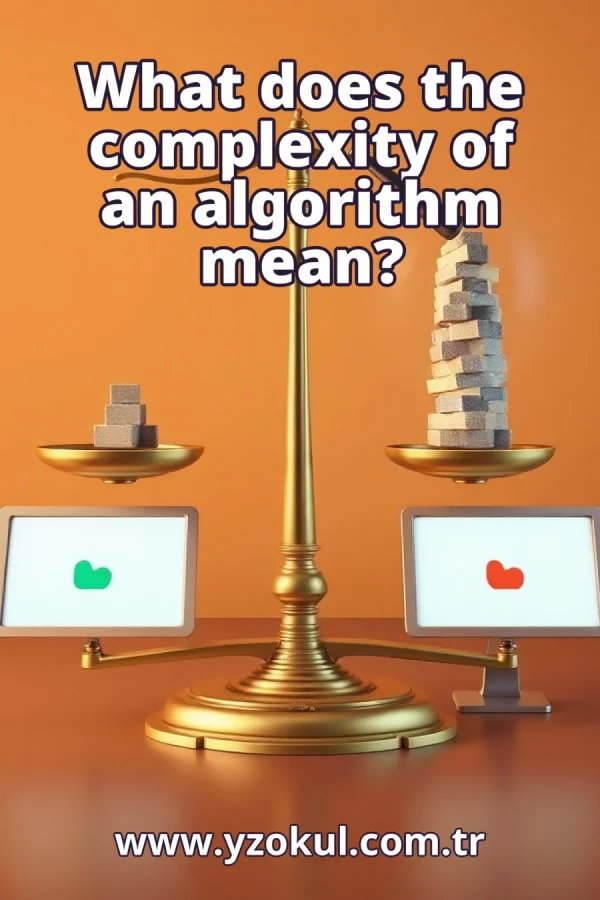
What does the complexity of an algorithm mean?
www.yzokul.com.tr
- Category AI Resources
- Format PDF
- Size 6.7 MB
- Added 01.11.2026
- Views 1
This book answers the question of what algorithm complexity means, starting from zero for complete beginners. It explains that complexity describes how the time or memory an algorithm needs grows as the data gets larger. It compares simple examples, such as checking each item once versus comparing all pairs, to show that different methods grow differently. It then introduces Big O notation as a general way to express this growth behavior, noting that it does not measure seconds directly but helps compare how algorithms scale.
Read the Book
If the PDF does not appear, open it in a new tab.
A Chapter from the Book
What does the complexity of an algorithm mean? www.yzokul.com.tr
What does the complexity of an algorithm mean? Complexity describes how the time or memory an algorithm needs grows as the data gets larger. It is not about the exact number of seconds on a particular machine. Instead, it is about the pattern of growth: how the work increases when you give the algorithm more data. This book explains that idea step by step. 1
An algorithm is a step-by-step method for doing a task, like a recipe. You give it data, and it produces a result. For example, a sorting algorithm takes a list of numbers and returns the list in order. The algorithm is the set of instructions, not the computer that runs it. Complexity describes how those instructions behave as the data grows. 2
The same algorithm takes different amounts of work depending on how much data you give it. A list of 10 items is handled differently from a list of 10,000 items. With more data, the algorithm may need more steps or more memory. Complexity captures this change: it tells you how the work scales when the data size increases. Data size matters for understanding complexity. 3
To study complexity, count the basic steps an algorithm performs instead of timing it with a clock. Step counts are more reliable because they do not depend on the computer's speed. For example, count how many times the algorithm compares two numbers or moves an item. This count gives a clear measure of the work done, independent of hardware. 4
Picture a method that looks at every item in a list exactly one time. For example, finding the largest number by checking each item once. If the list has n items, the method takes about n steps. If the list doubles, the work doubles. So the steps grow in step with the data. This is a simple growth pattern: work proportional to data size. 5
Now picture a method that compares every item with every other item. For example, checking all pairs to find duplicates. If the list has n items, there are about n times n pairs, so the method takes about n squared steps. If the list doubles, the work grows about four times. This grows much faster than the data. 6
Compare the two methods on the same growing lists. For n = 10, checking each item once takes about 10 steps, while comparing all pairs takes about 100 steps. For n = 100, the first takes about 100 steps, the second about 10,000 steps. The step counts separate more and more as data grows. Different methods grow differently. 7
Complexity is about the pattern of growth, not the exact step count. We care how the work scales, not whether it is 100 or 105 steps. Small differences in step counts do not matter much when data is large. What matters is whether the work grows linearly, quadratically, or in some other way. Focus on the trend. 8
Big O notation is a short general way to write down a growth pattern. It captures the main trend and ignores small details. For example, O(n) means the work grows roughly in proportion to the data size. O(n squared) means the work grows roughly with the square of the data size. Big O helps you compare algorithms quickly. 9
See the two earlier methods written in Big O. Checking each item once is O(n): the work grows linearly with n. Comparing all pairs is O(n squared): the work grows with n times n. Match each symbol to its growth pattern: O(n) for linear growth, O(n squared) for quadratic growth. These labels summarize how the work scales. 10
Big O is not seconds. O(n) does not mean n seconds or any fixed time. It is a general description of growth, not a stopwatch measurement. Two algorithms both O(n) may run at different speeds on a given machine, but their growth behavior is similar. Big O compares how they scale, not how fast they run right now. 11
Big O drops constants and minor terms because as data grows large, the main trend dominates. For example, an algorithm that takes 3n + 5 steps is still O(n). The constant 3 and the added 5 matter little when n is huge. Ignoring them keeps comparisons simple and fair. Focus on the dominant growth term. 12
Complexity also covers memory, not just time. An algorithm that stores a copy of every item needs more memory as the data grows. For example, creating a new list of the same size takes O(n) memory. If it creates a table of all pairs, it takes O(n squared) memory. Memory growth is part of complexity. 13
A common mistake is judging complexity by how fast one machine runs the algorithm. Speed depends on hardware, but growth behavior stays the same. A slow computer may take longer for small data, but the pattern of growth with larger data is what defines complexity. Compare step counts or growth patterns, not raw seconds on one machine. 14
Another common mistake is testing only tiny inputs. On small data, both a linear method and a quadratic method may look fine. The difference appears as the data grows. For example, with 10 items, 10 steps and 100 steps are both quick. With 10,000 items, 10,000 steps versus 100,000,000 steps is a huge difference. Always consider larger data.
This section is a preview taken from the book (about 906 words). To continue, read the book or download the PDF.
Book Details
- Book
- What does the complexity of an algorithm mean?
- Author
- www.yzokul.com.tr
- Category
- AI Resources
- Language
- English
- Format
- PDF · 6.7 MB
- Pages
- 18
- Words
- about 961
- Published
- kaynak.yzokul.com.tr · 01.11.2026
- Access
- Free to read and download; for personal use only, all rights belong to the author.
Frequently Asked Questions
Is the PDF of What does the complexity of an algorithm mean? free?
Yes. What does the complexity of an algorithm mean? can be read and downloaded for free on this site; no sign-up or payment is required.
How many pages is What does the complexity of an algorithm mean??
What does the complexity of an algorithm mean? has 18 pages and about 961 words.
Which devices can I read What does the complexity of an algorithm mean? on?
It is a PDF; you can read it in your browser on a phone, tablet or computer, or download it and open it offline.
Who is the author of What does the complexity of an algorithm mean??
What does the complexity of an algorithm mean? was written by www.yzokul.com.tr; it is listed in the AI Resources category.
Similar Books
 What is artificial intelligence?
www.yzokul.com.tr
 How does an app idea turn into a working program?
www.yzokul.com.tr
 What is simulation?
www.yzokul.com.tr
 What is the difference between a microcontroller and a normal computer?
www.yzokul.com.tr
 What is a microcontroller?
www.yzokul.com.tr
 How do you make a simple calculator with code?
www.yzokul.com.tr