
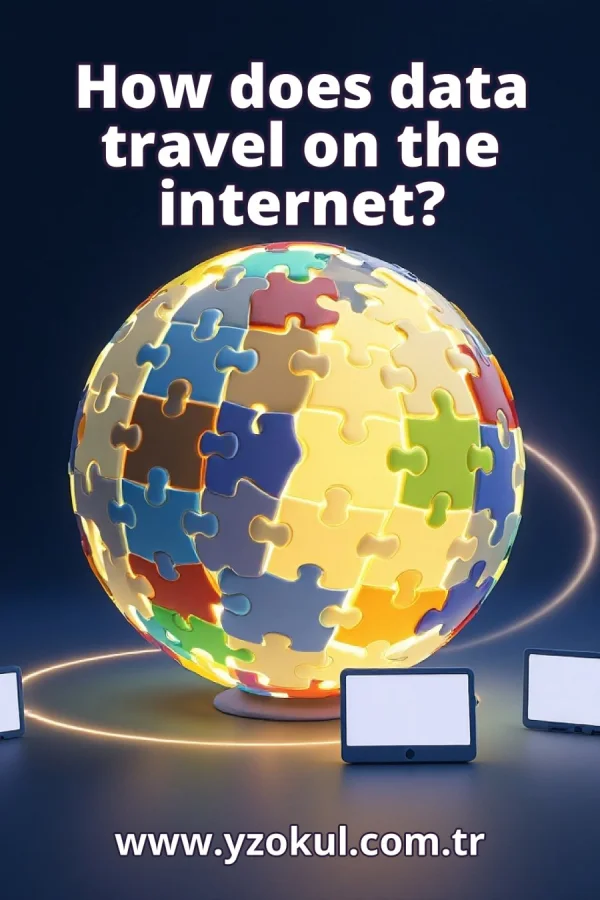
How does data travel on the internet?
www.yzokul.com.tr
- Category AI Resources
- Format PDF
- Size 7.6 MB
- Added 01.11.2026
- Views 1
This book answers the question of how data travels on the internet, starting from zero for complete beginners. It explains that information is broken into data packets, which carry address and control information so they can reach the right destination. Network devices handle internet routing by sending packets along appropriate connections. The receiving system then reassembles and uses the data. The book also shows that packets may take different paths, and that how problems like packet loss and ordering are handled depends on the protocols used.
Read the Book
If the PDF does not appear, open it in a new tab.
Table of Contents
- 1 to 100, so the receiver can reassemble them correctly even ifp. 7
A Chapter from the Book: 1 to 100, so the receiver can reassemble them correctly even if
You see that packets also carry control information, such as a number showing their place in the sequence. This helps the receiver put the pieces back in the right order. For example, if a video is split into 100 packets, each packet is numbered from 1 to 100, so the receiver can reassemble them correctly even if they arrive out of order. 5
You understand that packets travel through communication systems, such as cables and wireless links. These systems move packets from one point to the next. For example, a packet might go from your computer through a Wi-Fi link to your router, then through a cable to your internet service provider, and onward through many other links. 6
You see network devices along the way that read the address information on each packet. They send each packet onward through the appropriate connection toward its destination. For example, a router at your internet service provider examines the destination address and decides which neighboring network to forward the packet to, like a mail sorting office. 7
You understand that packets from the same message do not always travel the same path. Each packet can take a different route depending on what connections are available. For example, one packet might go through a route with less traffic, while another takes a different route, and they may arrive at different times but still reach the same destination. 8
You follow packets as they reach the receiving system. The receiving system collects the incoming packets that belong to the same message. For example, your friend's computer receives packets from your email, identifies them by the source address and sequence numbers, and gathers them together for reassembly. 9
You see the receiving system use the control information to put the packets back in the correct order. Then it rebuilds the original message from the pieces. For example, if packets numbered 3, 1, and 2 arrive, the receiver reorders them as 1, 2, 3 and combines their data to recreate the full email. 10
You understand that after reassembly, the receiving system makes the necessary arrangements and uses the data. For example, it shows the message or plays the video. The receiving system might display the email in your inbox or start streaming the video you requested, using the reassembled data as if it were never split. 11
You learn that a packet can sometimes fail to arrive at the destination. What happens next depends on the protocol being used. For example, if a packet is lost, some protocols might request it to be sent again, while others might ignore the loss and continue, which could cause a small glitch in a video call. 12
You understand that packets may arrive in a different order than they were sent. Handling this ordering problem also depends on the protocol. For example, a protocol might use sequence numbers to reorder packets before delivering the data, or it might deliver them as they arrive and let the application handle the disorder. 13
You see that a protocol is a set of agreed rules for communication. The protocol decides how lost packets and out-of-order packets are managed. For example, the Transmission Control Protocol (TCP) ensures reliable delivery by acknowledging received packets and retransmitting lost ones, while the User Datagram Protocol (UDP) does not guarantee delivery or order. 14
You correct the common mistake that data travels as one whole piece. In fact, it is split into many packets that may take different paths and arrive separately. For example, when you download a file, it is broken into packets that might travel through different routes and be reassembled at your computer, not sent as a single unit. 15
You sum up the answer: data is split into packets with address and control information, routed by network devices, and reassembled by the receiver. Remember that paths can differ and that protocols handle loss and ordering. For example, sending an email involves all these steps, ensuring your message reaches your friend intact, even across the global internet. 16
This section is a preview taken from the book (about 675 words). To continue, read the book or download the PDF.
Book Details
- Book
- How does data travel on the internet?
- Author
- www.yzokul.com.tr
- Category
- AI Resources
- Language
- English
- Format
- PDF · 7.6 MB
- Pages
- 18
- Words
- about 924
- Chapters
- 1
- Published
- kaynak.yzokul.com.tr · 01.11.2026
- Access
- Free to read and download; for personal use only, all rights belong to the author.
Frequently Asked Questions
Is the PDF of How does data travel on the internet? free?
Yes. How does data travel on the internet? can be read and downloaded for free on this site; no sign-up or payment is required.
How many pages is How does data travel on the internet??
How does data travel on the internet? has 18 pages and about 924 words.
Which devices can I read How does data travel on the internet? on?
It is a PDF; you can read it in your browser on a phone, tablet or computer, or download it and open it offline.
Who is the author of How does data travel on the internet??
How does data travel on the internet? was written by www.yzokul.com.tr; it is listed in the AI Resources category.
Similar Books
 What is artificial intelligence?
www.yzokul.com.tr
 How does an app idea turn into a working program?
www.yzokul.com.tr
 How does a three-dimensional printer produce a model?
www.yzokul.com.tr
 What is simulation?
www.yzokul.com.tr
 What is the difference between a microcontroller and a normal computer?
www.yzokul.com.tr
 What is a microcontroller?
www.yzokul.com.tr