
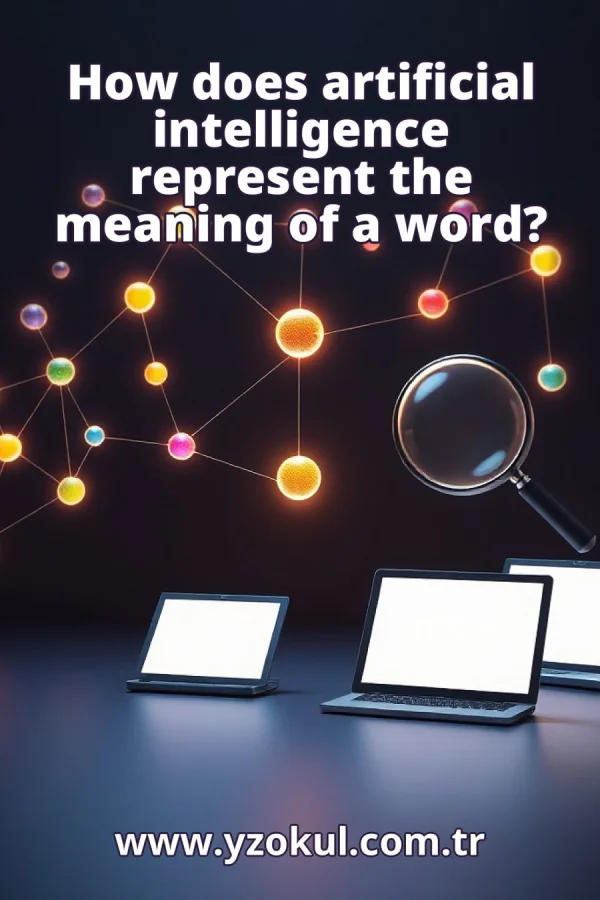
How does artificial intelligence represent the meaning of a word?
www.yzokul.com.tr
- Category AI Resources
- Format PDF
- Size 6.4 MB
- Added 01.11.2026
- Views 2
This book answers the question of how artificial intelligence represents the meaning of a word. It follows a beginner-friendly path, explaining that AI models turn words into number vectors that capture usage context and word relationships. Words used in similar contexts end up close together, though this is not the same as dictionary meaning. The book also shows how models use context differences to tell when the same word means different things in different sentences.
Read the Book
If the PDF does not appear, open it in a new tab.
A Chapter from the Book
How does artificial intelligence represent the meaning of a word? www.yzokul.com.tr
How does artificial intelligence represent the meaning of a word? The short answer is that AI turns words into lists of numbers that capture how words are used. These numbers are not definitions but patterns from many sentences. For example, the word cat might become a list like [0.2, -0.5, 0.8]. This list represents the word's meaning in a way a computer can process. 1
A computer cannot work with letters directly; it needs numbers. So each word is first turned into a set of numbers. This is the starting point for everything that follows. For instance, the word dog might be assigned numbers such as 3, 1, and 4. These numbers are not random; they are learned from how the word is used. 2
The numbers for one word form a list called a vector. Picture it as a row of boxes, each holding a number. For example, the vector for apple could be [0.1, 0.7, -0.3]. Each number in the list is a coordinate that helps place the word in a mathematical space. Vectors are the basic building blocks for representing meaning. 3
A list of numbers can be drawn as a point in space. Two numbers give a flat map; more numbers just add more directions. For example, a vector with two numbers [2, 3] is a point on a flat grid. A vector with three numbers [2, 3, 1] is a point in a 3D space. More numbers mean more dimensions, but the idea is the same. 4
Words used in similar contexts end up as points close together. The distance between points reflects how alike the words are used. For example, cat and dog often appear in similar sentences, so their vectors are close. This closeness is a key property of how AI represents meaning: similar usage leads to nearby points. 5
Closeness is measured with a simple distance or angle between points. This gives a number saying how similar two words are. For instance, you can compute the Euclidean distance between two vectors: the smaller the distance, the more similar the words. Another measure is cosine similarity, which looks at the angle between vectors. Both help quantify similarity. 6
The numbers come from the sentences a word appears in. Words that show up around the same other words get similar vectors. For example, if cat and dog both often appear near feed, pet, and vet, their vectors will be similar. The model learns these patterns by processing large amounts of text, adjusting numbers to capture co-occurrence. 7
This closeness is not the same as dictionary meaning. It reflects patterns of usage, not definitions written by people. For example, the vectors might place cat and dog close because they are used similarly, but the vector does not contain the definition a furry animal. It only encodes statistical associations from context. 8
One word can mean different things in different sentences. The model must notice which sentence the word sits in. For example, bank in river bank and bank in money bank has different meanings. A good model should produce different vectors for bank in each context. This is called context sensitivity. 9
The model looks at the words around a word to guess its role. The neighbors help decide which meaning is meant. For example, in the sentence the fisherman sat on the bank, the words fisherman and river suggest the land meaning. In she deposited money in the bank, the words money and deposited suggest the financial meaning. 10
The same word can get a slightly different vector in each sentence. The context shifts the numbers toward the right meaning. For example, the vector for bank in a river context might be closer to vectors for shore and water, while in a financial context it might be closer to money and account. This shift captures the sense. 11
Comparing these context-based vectors lets the model separate the senses of a word. Different sentences give different, distinguishable points. For example, the vector for bank in a river sentence and the vector for bank in a money sentence will be far apart. By comparing them, the model can tell the meanings apart. 12
Put the pieces together: words become points, context moves the points, and closeness shows similarity. This ties the earlier steps into one view. For example, cat and dog are close because they are used similarly, but bank in two sentences lands in different places. This picture summarizes how AI represents word meaning. 13
A common mistake is thinking the vectors store dictionary definitions. They store usage patterns, which is related but not the same. For example, the vector for cat does not contain the definition a small domesticated carnivorous mammal. It only contains numbers that reflect how cat is used in text. Meaning here is usage, not a written definition. 14
Another mistake is thinking a word always has a single fixed vector. In context, the same word can land in different places. For example, the word bank does not have one vector; it has different vectors in different sentences. This flexibility is essential for handling ambiguity and is a core feature of modern AI models. 15
AI represents word meaning as number vectors shaped by context, and closeness shows similar use, not dictionary meaning. Remember that context lets the model tell senses apart. For example, cat and dog are close because they are used similarly, while bank in two sentences lands in different places. This is the essence of how AI captures meaning.
This section is a preview taken from the book (about 932 words). To continue, read the book or download the PDF.
Book Details
- Book
- How does artificial intelligence represent the meaning of a word?
- Author
- www.yzokul.com.tr
- Category
- AI Resources
- Language
- English
- Format
- PDF · 6.4 MB
- Pages
- 18
- Words
- about 933
- Published
- kaynak.yzokul.com.tr · 01.11.2026
- Access
- Free to read and download; for personal use only, all rights belong to the author.
Frequently Asked Questions
Is the PDF of How does artificial intelligence represent the meaning of a word? free?
Yes. How does artificial intelligence represent the meaning of a word? can be read and downloaded for free on this site; no sign-up or payment is required.
How many pages is How does artificial intelligence represent the meaning of a word??
How does artificial intelligence represent the meaning of a word? has 18 pages and about 933 words.
Which devices can I read How does artificial intelligence represent the meaning of a word? on?
It is a PDF; you can read it in your browser on a phone, tablet or computer, or download it and open it offline.
Who is the author of How does artificial intelligence represent the meaning of a word??
How does artificial intelligence represent the meaning of a word? was written by www.yzokul.com.tr; it is listed in the AI Resources category.
Similar Books
 What is artificial intelligence?
www.yzokul.com.tr
 How does an app idea turn into a working program?
www.yzokul.com.tr
 What is the difference between virtual reality and augmented reality?
www.yzokul.com.tr
 How does a three-dimensional printer produce a model?
www.yzokul.com.tr
 What is simulation?
www.yzokul.com.tr
 How does a robot find the shortest path?
www.yzokul.com.tr