
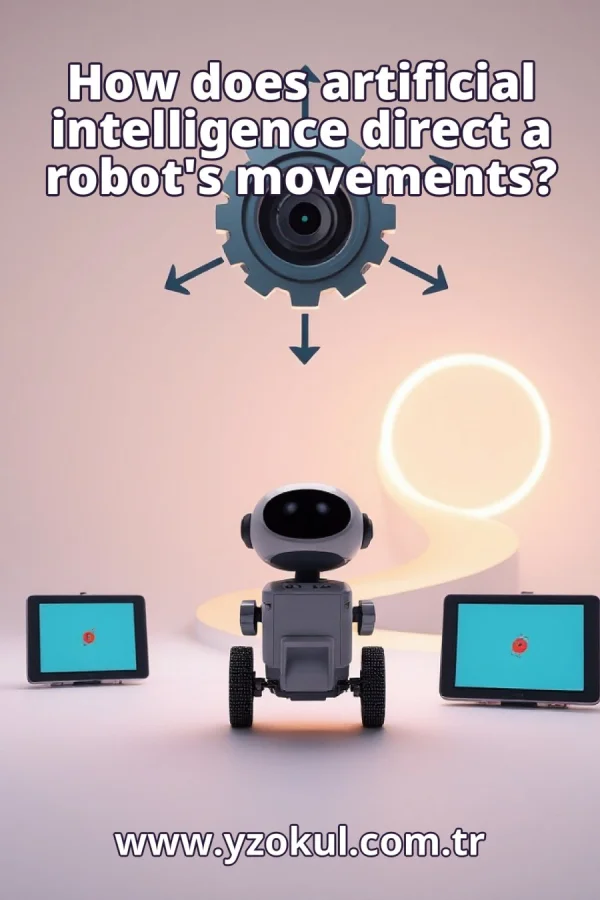
How does artificial intelligence direct a robot's movements?
www.yzokul.com.tr
- Category AI Resources
- Format PDF
- Size 6.5 MB
- Added 01.11.2026
- Views 1
This beginner-friendly book explains how artificial intelligence directs a robot's movements. It answers the question by following a clear path: first, cameras and sensors gather data about the surroundings; next, software uses this data to judge position, obstacles and the target; then it creates a movement plan and sends commands to the motors, letting the robot change direction to avoid a table. The book stresses that sensing, planning and motor control are separate tasks, and artificial intelligence is not required at every stage.
Read the Book
If the PDF does not appear, open it in a new tab.
A Chapter from the Book
How does artificial intelligence direct a robot's movements? www.yzokul.com.tr
You want to know how artificial intelligence, or AI, directs a robot's movements. The short answer: cameras and sensors gather data about the surroundings, software judges the robot's position, obstacles, and target, a movement plan is made, and commands are sent to the motors. AI may help in some of these steps, but not necessarily all. This book explains each part step by step. 1
A robot is a machine with a body, motors that move it, and a computer that controls it. It has no mind of its own; everything it does comes from instructions and data. The computer runs software, which is a set of programs that tell the robot what to do. The motors turn wheels or joints to produce movement. Without software and data, the robot cannot act. 2
Cameras and sensors are the robot's eyes and ears. They collect information about the surroundings, such as what is nearby and how far away it is. A camera captures images, while sensors like distance sensors measure how close objects are. This data is sent to the robot's computer for processing. Good data is the foundation for any movement. 3
Raw sensor data is turned into a simple picture of the world around the robot. This picture shows where things are, including a table in the robot's path. The software processes the data to create a map or model of the environment. This internal picture helps the robot understand its surroundings. It is not a photo but a representation of objects and their locations. 4
The software works out where the robot itself is standing. Without knowing its own position, the robot cannot decide which way to go. It uses sensor data to estimate its location relative to known landmarks or its starting point. This process is called localization. Knowing its position is essential for planning a path to the target. 5
The software checks the picture for obstacles, like the table. It marks these as places the robot should not run into. Obstacles can be detected by sensors that measure distance or by analyzing camera images. The software identifies their size and location. Avoiding obstacles is crucial for safe movement. 6
The robot also needs a goal, such as a spot across the room. The software compares the target with the robot's current position. The target might be given by a human or set by a program. Knowing both the target and the robot's position allows the software to determine the direction to move. The goal guides the planning process. 7
The software creates a simple plan: a path from the robot to the target that avoids the obstacles. This plan is the decision about how to move. It might be a straight line or a series of turns. The planning step considers the robot's size and the space available. The result is a set of waypoints or directions. 8
The plan is turned into commands sent to the motors. The motors then turn the wheels or joints, and the robot starts to move. These commands specify how fast and in which direction each motor should turn. The motor control part translates the plan into electrical signals. This is the execution of the movement plan. 9
Imagine a table blocks the way. The robot's sensors detect the table, and the software plans a path around it. The plan might say to turn slightly and then move forward. The motor commands are adjusted accordingly: one wheel turns faster than the other. The robot changes direction and moves past the table without hitting it. 10
Sensing, planning, and motor control are three different jobs. Each job can be done by its own part of the software. Sensing gathers data, planning decides the path, and motor control executes the commands. Keeping them separate makes the system easier to design and fix. They work together in a sequence. 11
Using artificial intelligence at every stage is not mandatory. Some robots move well with simple rules, and AI may help only in some of the three tasks. For example, AI might be used for recognizing obstacles in camera images, while planning uses a simple algorithm. The choice depends on the task's complexity. AI is a tool, not a requirement. 12
A common mistake is to think that AI itself looks through the camera. The camera and sensors gather the data; software, with or without AI, uses that data. AI might help interpret the data, but the sensors do the seeing. The software processes the raw information into a usable form. AI is not the sensor. 13
Another mistake is to believe that AI directly spins the motors. The plan becomes commands, and the motor control part carries them out. AI may help create the plan, but the actual motor signals are generated by control software. The motors respond to electrical commands, not to AI directly. Motor control is a separate step. 14
It is wrong to think that one single AI does everything at once. Sensing, planning, and motor control are separate steps that work together in order. Each step has its own role and may use different methods. AI might be used in one or more steps, but not necessarily all. The steps are distinct and sequential. 15
To sum up: sensors gather data, software judges position, obstacles, and target, a plan is made, and commands reach the motors. Remember that these are separate tasks, and AI is not required at every stage. The robot moves by following this sequence. Understanding each part helps you see how AI can direct movement.
This section is a preview taken from the book (about 939 words). To continue, read the book or download the PDF.
Book Details
- Book
- How does artificial intelligence direct a robot's movements?
- Author
- www.yzokul.com.tr
- Category
- AI Resources
- Language
- English
- Format
- PDF · 6.5 MB
- Pages
- 18
- Words
- about 940
- Published
- kaynak.yzokul.com.tr · 01.11.2026
- Access
- Free to read and download; for personal use only, all rights belong to the author.
Frequently Asked Questions
Is the PDF of How does artificial intelligence direct a robot's movements? free?
Yes. How does artificial intelligence direct a robot's movements? can be read and downloaded for free on this site; no sign-up or payment is required.
How many pages is How does artificial intelligence direct a robot's movements??
How does artificial intelligence direct a robot's movements? has 18 pages and about 940 words.
Which devices can I read How does artificial intelligence direct a robot's movements? on?
It is a PDF; you can read it in your browser on a phone, tablet or computer, or download it and open it offline.
Who is the author of How does artificial intelligence direct a robot's movements??
How does artificial intelligence direct a robot's movements? was written by www.yzokul.com.tr; it is listed in the AI Resources category.
Similar Books
 What is artificial intelligence?
www.yzokul.com.tr
 How does an app idea turn into a working program?
www.yzokul.com.tr
 How does a three-dimensional printer produce a model?
www.yzokul.com.tr
 What is simulation?
www.yzokul.com.tr
 What is the difference between a microcontroller and a normal computer?
www.yzokul.com.tr
 What is a microcontroller?
www.yzokul.com.tr