
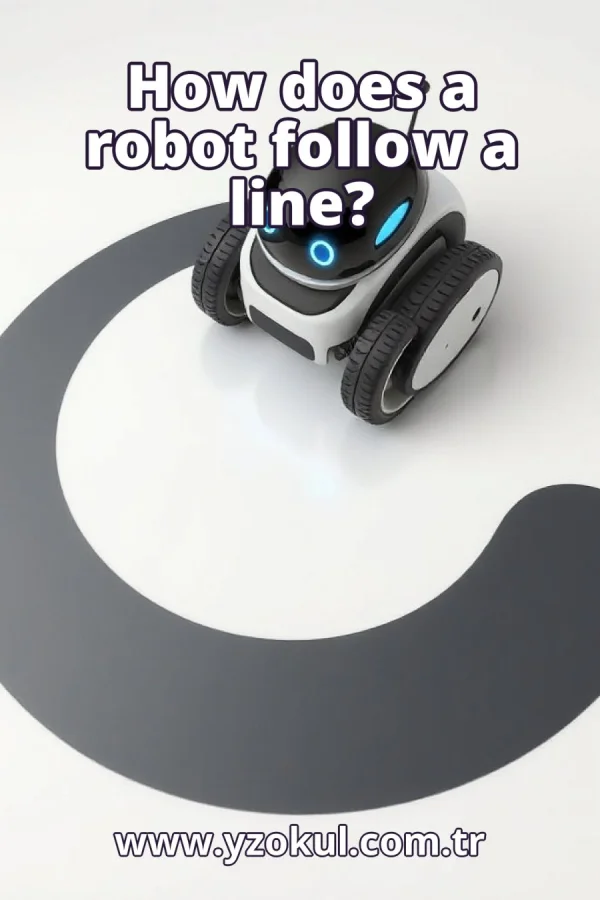
How does a robot follow a line?
www.yzokul.com.tr
- Category AI Resources
- Format PDF
- Size 6.5 MB
- Added 01.11.2026
- Views 1
This book answers the question of how a robot follows a line. It explains the path from zero: sensors measure brightness or reflection differences on the ground, and motor speeds change based on whether the line is to the right or left. If the line shifts left, the robot corrects its direction to the left, repeating this continuously. The book shows that small corrections suited to each measurement, rather than only sharp turns, produce smoother movement.
Read the Book
If the PDF does not appear, open it in a new tab.
A Chapter from the Book
How does a robot follow a line? www.yzokul.com.tr
How does a robot follow a line? The short answer: sensors measure light on the ground, and the robot changes its motor speeds to stay on the line. The line and the floor around it reflect different amounts of light, so the sensors can tell them apart. By adjusting the speeds of its motors, the robot turns to keep the line under its sensors. 1
A simple line-following robot has two wheels, each driven by its own motor, and sensors pointing down at the floor. The sensors are usually placed at the front, close to the ground. This setup is all the robot needs: two motors to move and steer, and sensors to read the floor. No other parts are required for basic line following. 2
The robot follows a line drawn on the floor. The line can be dark on a light surface, or light on a dark surface. What matters is that the line and the surrounding floor reflect light differently. The robot's job is to keep its sensors over the line as it moves forward. This difference in reflection is what the sensors detect. 3
Sensors on the robot measure how much light comes back from the ground. A dark line absorbs more light and reflects less; a light floor reflects more. The sensor produces a reading that differs between the line and the floor. By comparing these readings, the robot knows whether it is over the line or not. This is the basis for following the line. 4
Two sensors are placed side by side, one left and one right of the robot's center. Each sensor reports whether it sees the line or the floor. With two readings, the robot can tell not only if it is on the line but also which side the line is on. This left-right information is key to steering. 5
When both sensors read the same—either both see the line or both see the floor—the line is centered under the robot. In this case, the robot drives straight ahead by running both motors at equal speed. Equal motor speeds keep the robot moving forward without turning. This is the desired state for smooth line following. 6
If the line shifts to the left, the left sensor sees the line while the right sensor sees the floor. This tells the robot that the line is now to its left. The robot must turn left to get back on the line. The sensor readings provide the direction for correction. 7
To correct to the left, the robot slows its left motor and speeds up its right motor. The slower left wheel and faster right wheel make the robot turn left. This turning brings the sensors back over the line. The amount of speed change can be small or large, depending on how far off the line the robot is. 8
When the line shifts to the right, the right sensor sees the line and the left sensor sees the floor. The robot then slows its right motor and speeds up its left motor. This turns the robot to the right, back toward the line. The principle is the same as for a left shift, just mirrored. 9
The robot checks its sensors many times every second—often hundreds or thousands of times. Each check leads to a small motor speed adjustment. This happens continuously as the robot moves, without stopping. The rapid repetition allows the robot to react quickly to changes in the line's position. It is a constant loop of sensing and correcting. 10
Small corrections suited to each sensor reading produce smoother movement. Instead of making sharp turns, the robot makes tiny speed changes that keep it gliding along the line. For example, if the line is slightly off-center, a small speed difference between motors is enough to correct. This gentle approach avoids jerky motion and keeps the robot stable. 11
A robot that only makes hard turns will swing past the line and wobble. When it detects the line off to one side, it turns sharply, overshooting the line. Then it must correct back, causing zigzag motion. Smooth movement comes from proportional corrections: the farther off the line, the stronger the correction, but always in small increments. 12
A common mistake is turning the wrong way when the line shifts. If the line is to the left but the robot turns right, it moves away from the line and quickly loses it. Always match the turn direction to the sensor that sees the line. Doublecheck the wiring and code so that left sensor triggers a left turn. 13
Driving too fast is another mistake. If the robot moves quickly, it may pass over the line before the sensors can detect and correct. The robot then loses the line. Slower speeds give the sensors and motors time to react. Adjust the speed so that the robot can complete a correction before moving too far. 14
Shadows or a shiny floor can fool the sensors by changing the amount of reflected light. A shadow might make the floor look dark like the line, or a shiny spot might look light. The robot needs reliable readings to decide how to turn. Use consistent lighting and test the sensors on the actual floor to ensure they distinguish line from floor. 15
To sum up: sensors compare brightness, motor speeds adjust left or right, and the robot repeats this continuously. Small, steady corrections keep it on the line. Remember to turn the correct way, drive at a suitable speed, and ensure reliable sensor readings. With these principles, a simple robot can follow a line smoothly.
This section is a preview taken from the book (about 948 words). To continue, read the book or download the PDF.
Book Details
- Book
- How does a robot follow a line?
- Author
- www.yzokul.com.tr
- Category
- AI Resources
- Language
- English
- Format
- PDF · 6.5 MB
- Pages
- 18
- Words
- about 949
- Published
- kaynak.yzokul.com.tr · 01.11.2026
- Access
- Free to read and download; for personal use only, all rights belong to the author.
Frequently Asked Questions
Is the PDF of How does a robot follow a line? free?
Yes. How does a robot follow a line? can be read and downloaded for free on this site; no sign-up or payment is required.
How many pages is How does a robot follow a line??
How does a robot follow a line? has 18 pages and about 949 words.
Which devices can I read How does a robot follow a line? on?
It is a PDF; you can read it in your browser on a phone, tablet or computer, or download it and open it offline.
Who is the author of How does a robot follow a line??
How does a robot follow a line? was written by www.yzokul.com.tr; it is listed in the AI Resources category.
Similar Books
 What is artificial intelligence?
www.yzokul.com.tr
 How does an app idea turn into a working program?
www.yzokul.com.tr
 How does a three-dimensional printer produce a model?
www.yzokul.com.tr
 What is simulation?
www.yzokul.com.tr
 What is the difference between a microcontroller and a normal computer?
www.yzokul.com.tr
 What is a microcontroller?
www.yzokul.com.tr