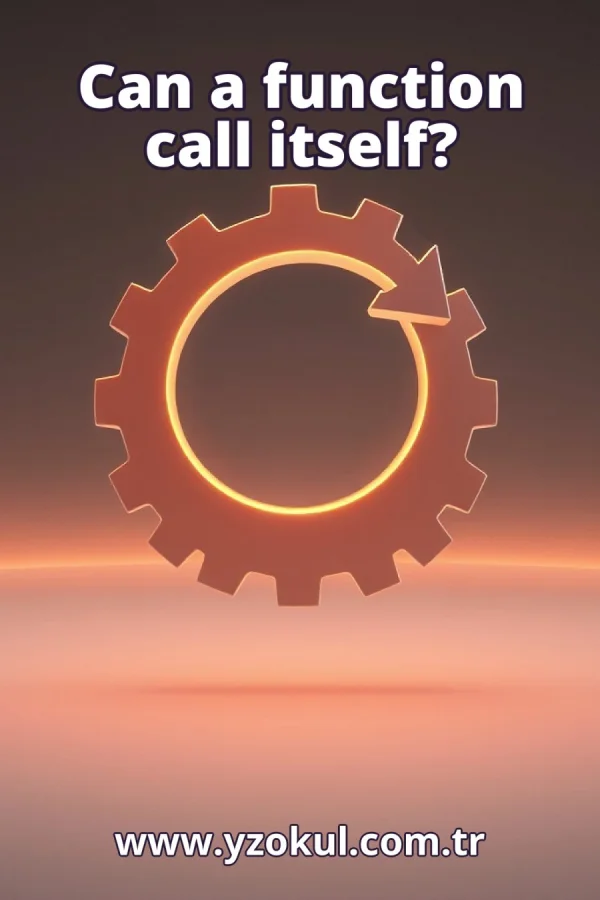
Can a function call itself?
www.yzokul.com.tr
- Category AI Resources
- Format PDF
- Size 7.2 MB
- Added 01.11.2026
- Views 1
This book answers whether a function can call itself. It explains that yes, a function calling itself is called recursion, and this is useful when a problem can be split into smaller similar problems, like checking nested folders. It also shows that there must be a base case where the calls stop, or the system's resource limits can be reached. The book follows a beginner-friendly path, explaining everything from zero with plain language and simple examples.
Read the Book
If the PDF does not appear, open it in a new tab.
A Chapter from the Book
Can a function call itself? www.yzokul.com.tr
You may wonder whether a function can call itself. The short answer is yes. When a function calls itself, this is called recursion. This book explains recursion step by step, starting from what a function is and ending with how to use recursion safely. You will see simple examples and learn why a stopping point is needed. 1
A function is a named block of instructions that does a job when you call it. Calling a function means asking it to run. For example, you might have a function called greet that prints a welcome message. When you write greet(), the instructions inside greet run. Functions help you organize code and reuse it without rewriting the same instructions. 2
Here is a simple example where one function calls another function to get a result. Suppose you have a function double that multiplies a number by two. Another function printDouble calls double and then prints the result. When you call printDouble(5), it calls double(5), gets 10, and prints 10. This shows that a function can trigger other code. 3
Now turn the idea around: a function's body can contain a call to itself. For example, a function countdown that prints a number and then calls countdown with a smaller number. That self-call is what recursion means. The function does not need a special keyword; it simply uses its own name inside its body. 4
Recursion is just the name for a function calling itself. Nothing new or magical happens; it is the same calling idea you already saw. When a function calls itself, the computer treats it like any other function call: it pauses the current work, runs the called function, and then continues. The only difference is that the called function is the same one. 5
Recursion is useful when a problem contains smaller versions of the same problem. Solving one small copy looks like solving the big one. For example, finding a file in a folder might involve searching each subfolder, which is the same task on a smaller scale. By calling itself on smaller pieces, the function can handle nested structures naturally. 6
Picture a folder that contains folders, which contain more folders. To check the contents of the whole folder, you need to check each subfolder in the same way. This is like a tree of folders. The same operation—listing files and looking inside subfolders—repeats at every level. Recursion fits this pattern well. 7
A folder-checking function can call itself on each subfolder. Each call does the same job on a smaller piece: list the items, and for each subfolder, call the function again. This way, the function handles any depth of nesting without you writing separate code for each level. The same logic applies at every level. 8
Self-calls cannot go on forever. There must be a point where the function stops calling itself. Otherwise, the function would keep calling itself with no end, like a loop that never finishes. To prevent this, every recursive function needs at least one situation where it does not make a self-call. That situation is called the base case. 9
The base case is the simple situation where the function returns an answer without calling itself. This is what ends the chain of calls. For example, in a countdown function, the base case might be when the number reaches zero: then the function stops and returns. Without a base case, the function would keep calling itself indefinitely. 10
Follow a small example with a clear base case and one selfcall. A function sumTo(n) returns the sum of numbers from 1 to n. If n is 1, it returns 1 (base case). Otherwise, it returns n plus sumTo(n-1). Calling sumTo(3) goes down to sumTo(1), then answers come back up: 1, then 3, then 6. 11
If a base case is missing or wrong, the calls continue without end. The program never finishes its work because each call makes another call. For example, a function that always calls itself with the same argument will never reach a stopping point. The computer will keep trying to run more calls until it runs out of resources. 12
Endless calls use up the system's limited resources. Each call takes memory and processing time. Eventually, the system's limits are reached and the program fails, often with an error like stack overflow. This is not dangerous, but it stops your program from working. So always include a base case to avoid this. 13
The most common error is writing the self-call but forgetting the base case. Before you run a recursive function, check that it has a clear stopping point. Ask yourself: what is the simplest case, and does the function return without calling itself there? If not, add that case. Every recursive function needs at least one base case. 14
A base case must actually be reached by the smaller problems. If the problem never shrinks to it, the calls still never stop. For example, if a function calls itself with the same number instead of a smaller one, the base case is never reached. Make sure each self-call works on a smaller or simpler version of the problem. 15
Yes, a function can call itself, and this is called recursion. Use it for problems that contain smaller similar problems, like nested folders. Always include a base case so the calls stop. Without a base case, the calls continue until the system's resource limits are reached. Check your recursive functions for a clear stopping point.
This section is a preview taken from the book (about 925 words). To continue, read the book or download the PDF.
Book Details
- Book
- Can a function call itself?
- Author
- www.yzokul.com.tr
- Category
- AI Resources
- Language
- English
- Format
- PDF · 7.2 MB
- Pages
- 18
- Words
- about 926
- Published
- kaynak.yzokul.com.tr · 01.11.2026
- Access
- Free to read and download; for personal use only, all rights belong to the author.
Frequently Asked Questions
Is the PDF of Can a function call itself? free?
Yes. Can a function call itself? can be read and downloaded for free on this site; no sign-up or payment is required.
How many pages is Can a function call itself??
Can a function call itself? has 18 pages and about 926 words.
Which devices can I read Can a function call itself? on?
It is a PDF; you can read it in your browser on a phone, tablet or computer, or download it and open it offline.
Who is the author of Can a function call itself??
Can a function call itself? was written by www.yzokul.com.tr; it is listed in the AI Resources category.